How to Build a Pool Party Charcuterie Board That Wows
When guests arrive, the first thing they reach for is the pool party charcuterie board. If they like what they see, they are already set to enjoy the party.
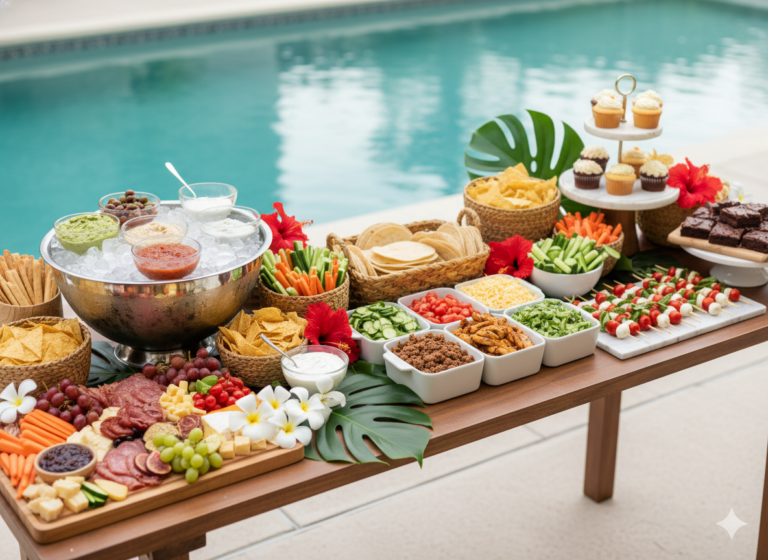
The pool party charcuterie board is the food table element that sets the tone for everything that follows. It is the food that runs through the full afternoon, holds without any management, and tells guests whether the host really thought about the food or not.
Get Brooke’s Free Pool Party Checklist
8 stages · 75+ checkpoints · print & tick your way to the perfect party
A well-built charcuterie board at a pool party does something that a plated starter or a passed canapé cannot do: it creates a gathering point. Guests cluster around it naturally. Conversations start at the board.
The host does not need to facilitate introductions because the board does it — people reach across for the same olive, and the conversation begins.
The pool party charcuterie board has specific requirements that an indoor dinner party board does not. It needs to hold in summer heat for two to three hours without the cheeses sweating, the meats oxidising, or the fruit wilting.
It needs to work as a grazing option for a varied crowd — meats, cheeses, dips, something sweet, something fresh, something for the person who does not eat either meat or cheese. And it needs to look as good at hour three as it did when it was first assembled.
This guide covers everything you need:
- the five components every pool party charcuterie board needs,
- the heat stability decisions that determine which items belong outdoors,
- the quantity calculations for boards of every size,
- the assembly approach that makes a board look designed rather than piled,
- and the theme-specific boards that carry the pool party’s color story all the way to the food table
Here is how to build the board that earns the compliment.
📣 Splash Bash Pass builds your complete charcuterie board shopping list with quantities matched to your guest count and party duration. Try it free →
The Five Components of a Pool Party Charcuterie Board
Every well-built charcuterie board at a pool party covers five components. Each one serves a specific function in the grazing experience. Miss one and the board feels incomplete — even if guests cannot identify exactly what is absent.
Component One: The Meats
The protein anchor of the board. Choose two or three cured meat varieties rather than one — variety in flavor and texture makes the board more interesting and accommodates guests who dislike specific cured meat types.
What works best outdoors:
Salami — hard-cured, low moisture, holds in heat for three hours without deteriorating. The most reliable outdoor charcuterie option.
Prosciutto — delicate in flavor, beautiful in photographs, but dries and darkens at the edges more quickly than hard salami in outdoor heat. Keep covered until service and replace with a fresh portion at the ninety-minute mark.
Pepperoni — bold in flavor, holds exceptionally well in heat, universally liked. The workhorse of the charcuterie board.
Chorizo — sliced thin, holds well, adds a smoky flavor note that distinguishes the board from a standard deli selection.
What to avoid outdoors:
Any cooked or semi-cooked deli meat — ham, turkey breast, mortadella — that requires refrigeration and deteriorates in taste and appearance within an hour in outdoor warmth.
The arrangement:
Fan slices in overlapping layers rather than stacking flat. A fanned arrangement of salami takes up more visual space and looks more abundant than the same number of slices stacked.
Fold prosciutto into loose ribbons rather than laying flat — the volume created by folding reads as more generous than flat slices.
Component Two: The Cheeses
Choose three to four cheeses with different textures and flavor intensities. The contrast across the selection is what makes the board interesting rather than any individual cheese.
The heat stability rule for outdoor charcuterie:
- Hard and semi-hard cheeses hold significantly better in outdoor summer conditions than soft cheeses.
- A parmesan or aged cheddar will look exactly the same at hour three as it did at hour one.
- A brie or camembert will have softened visibly, which is not necessarily unpleasant — soft, room-temperature brie is delicious — but it does change the visual of the board.
A reliable outdoor cheese selection:
An aged cheddar — sharp, hard, holds well, universally liked. The baseline cheese that every guest will eat.
A manchego or gouda — slightly softer than cheddar, nutty in flavor, holds well for two hours and then softens to a pleasant yielding texture rather than collapsing.
A soft cheese — brie, camembert, whipped ricotta, or burrata — served in its own bowl or with its base left intact. Soft cheeses are worth including despite their heat sensitivity because they are the cheeses guests specifically seek out.
Manage the heat impact by keeping the board in shade where possible and by replacing the soft cheese at the ninety-minute mark rather than at the first sign of deterioration.
A blue cheese — gorgonzola, stilton, roquefort — for guests who will specifically seek it out. Blue cheeses are the minority option, but they elevate the board’s sophistication level and are always appreciated by the guests who want them.
Hard blue cheeses hold better in heat than soft blues.
The arrangement:
Position cheeses at anchor points across the board — one at each end and one or two in the middle — so the visual structure of the board is created by the cheese positions and the other elements fill the space between them.
Component Three: The Crackers and Bread
The delivery vehicle for everything on the board. The cracker selection needs to be varied enough for guests to have texture choices and practical enough for the crackers to hold their structure in outdoor conditions.
What holds well outdoors:
Thick, dense crackers — water biscuits, wheat thins, rye crispbreads, rice crackers. These maintain their crunch in humidity because their low moisture content provides structural stability.
What does not hold well outdoors:
Thin, delicate crackers with high butter content — certain artisan crackers — absorb atmospheric moisture and soften within an hour in outdoor summer conditions. They are the right choice for an indoor board, not for an outdoor one.
Rustic bread:
Sliced baguette or sourdough on a board reads as more elevated than crackers alone. Add at the start of service with a second serving of fresh slices available at the ninety-minute mark, when the first batch may have dried slightly.
The arrangement:
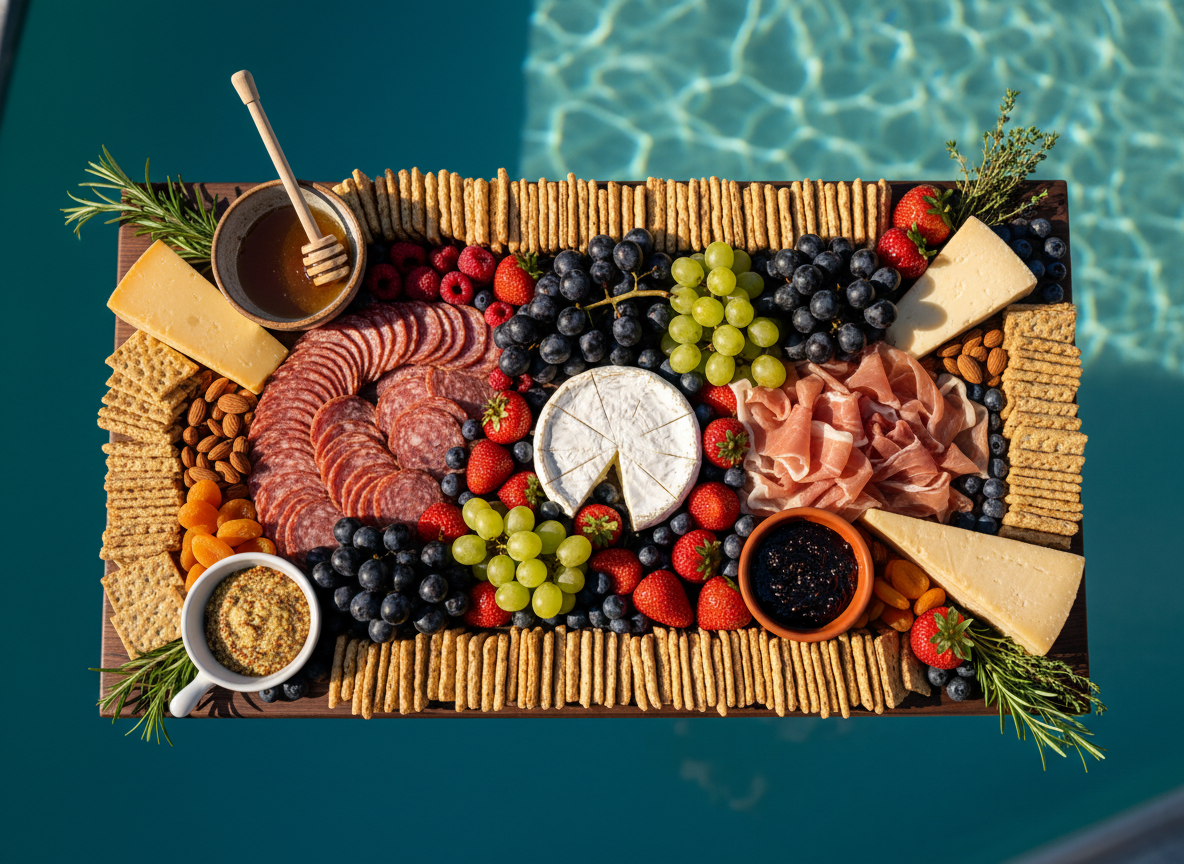
Cracker arrangement is where most boards either succeed or fail visually. Fan crackers in overlapping rows along the outer edges of the board. This creates a visual frame around the interior cheese and meat arrangement.
Avoid piling crackers in a central mound — they collapse, and the visual structure of the board deteriorates.
Component Four: The Sweet and Fresh Elements
The contrast layer that makes a charcuterie board interesting rather than a plate of meat and cheese.
Fruit:
Grapes are the default and the correct choice — they hold at room temperature for three hours, require no cutting, and can be eaten without utensils.
The visual of grape clusters draped across a board is one of the most universally recognisable charcuterie board images. Add black and green varieties for color contrast.
Sliced pear or apple adds freshness and color, but browns quickly once cut. Toss in a small amount of lemon juice immediately after cutting to slow oxidation. Replace at the ninety-minute mark.
Dried fruit — apricots, cranberries, figs, dates — holds indefinitely in outdoor conditions and adds deep sweetness that fresh fruit does not provide. An underused charcuterie element that significantly improves the board’s flavor range.
Fresh strawberries in summer: visually striking, hold well for two hours, broadly liked. Add to the board immediately before service rather than assembling in advance.
Honey and preserves:
A small bowl of good honey, a pot of fig jam, a small jar of whole grain mustard — these additions create an attraction that guests return to repeatedly.
The honey drizzled on the brie, the fig jam with the aged cheddar, the mustard with the salami. Each combination is specifically good rather than generically so.
Nuts and extras:
Marcona almonds, candied walnuts, pistachios — positioned in small clusters around the board or in individual small bowls. They provide textural contrast, hold indefinitely outdoors, and fill the visual gaps between larger elements.
Component Five: The Color Story
The charcuterie board at a themed pool party has one additional requirement: it should belong to the party’s color palette. This sounds prescriptive, and it does not need to be literal.
A board at a mermaid pool party should not have blue-dyed cheese. But choosing fruit, vegetables, and accompaniments in the palette colors — teal grapes, red berries, gold honey, green olives, coral-toned dried apricots — creates a board that reads as part of the party’s visual story rather than a generic food element sitting beside themed decorations.
At a tropical pool party: yellow mango slices, red strawberries, green kiwi, and orange dried apricots.
At a flamingo party: pink grapes, pink radish flowers, rose-tinted honey, blush-colored dried rose petals scattered across the board surface.
At a 4th of July party: red strawberries and raspberries, white cheese, blueberries — the flag palette delivered through the food.
This level of attention to the board’s visual is what makes a charcuterie board a party decoration as well as a food element.
Get Brooke’s Free Pool Party Checklist
8 stages · 75+ checkpoints · print & tick your way to the perfect party
Quantity Guide
The most common charcuterie board mistake at a pool party is building a beautiful board in the right proportions, but in the wrong total quantity.
As an arrival grazing option alongside a main meal:
| Guests | Cured meats | Cheese | Crackers | Fruit | Accompaniments |
|---|---|---|---|---|---|
| 10–15 | 10–14 oz | 10–14 oz | 7 oz | 2 cups | 3–4 small items |
| 20–25 | 18–25 oz | 18–25 oz | 12 oz | 3–4 cups | 4–5 small items |
| 30–40 | 28–35 oz (1¾–2¼ lb) | 28–35 oz (1¾–2¼ lb) | 18 oz | 5–6 cups | 5–6 small items |
| 50+ | 3¼–4½ lb | 3¼–4½ lb | 26 oz+ | 8+ cups | 6+ small items |
As the primary food for a cocktail-style event without a main meal: Double the above quantities.
Replenishment rule: Prepare one additional portion of each meat and cheese equivalent to sixty percent of the initial quantity, kept refrigerated. Bring it out at the ninety-minute mark to refresh the board.
Sourcing all the items, in the right quantities can be quite a challenge. Don’t sweat. Enlist Marina, your AI pool party specialist inside Splash Bash Pass.
📣 Splash Bash Pass builds your complete charcuterie board shopping list with quantities matched to your guest count and party duration. Marina will even find the best retail shops near you. Try it now →
The Assembly Approach
The visual quality of a charcuterie board is determined almost entirely by the assembly method rather than the ingredient quality.
Step One: Position the Anchor Elements
Place the cheeses first. These are the largest elements, and their positions create the structure around which everything else arranges itself. Position one cheese at each end of the board and one in the center.
Add the small individual bowls — for dips, honey, olives, mustard — before the other elements, since their positions are fixed once placed.
Step Two: Fill the Meat Zones
Add the cured meats in fanned or folded arrangements between the cheese anchors. The meat zones fill the spaces between cheeses — they do not overlap with the cheeses or crowd the individual bowls.
Use different arrangement styles for different meats: salami fanned in overlapping circles, prosciutto folded into loose ribbons, pepperoni layered in a slight overlap. The variation in arrangement style reads as considered rather than uniform.
Step Three: Add the Crackers as Borders
Fan crackers in overlapping rows along the outer edges of the board — one side for one type of cracker, the opposite side for another. The crackers create a visual frame and define the boundary of the board without requiring any separate display vessel.
Step Four: Fill the Gaps with Color
Add fruit, nuts, and dried items in the gaps between the larger elements. This is the step that transforms a functional board into a visually beautiful one.
Place the clusters of grapes, draped between the cheese blocks, the blueberries filling the small space beside the brie, the almonds scattered across the edge where there would otherwise be bare board surface.
At this stage, look at the board from above and identify any area that reads as bare or monochromatic. Add a contrasting color element — a different fruit, a different nut, a small cluster of fresh herbs — to every bare spot.
Step Five: The Finishing Layer
Fresh herbs — rosemary sprigs, fresh thyme, fresh basil — placed at the corners and along the outer edges of the board. Edible flowers, if they suit the party’s aesthetic. A light drizzle of honey directly over the soft cheese.
These finishing elements are the ones that separate a home-assembled board from one that looks professionally styled. They cost almost nothing, and they add a layer of freshness that the other components do not provide.
The Volume Principle
A well-assembled charcuterie board should look abundant. Not neat. Not symmetrical. Abundant.
The boards that earn the compliment are the ones that look like they might be slightly too much — grapes spilling over the edge, salami fanned beyond the cheese, crackers arranged right to the board’s perimeter.
This is achieved by starting with the right quantity of ingredients and by piling and clustering rather than spacing and arranging.
Spacing food on a charcuterie board communicates scarcity. Clustering food communicates abundance. Abundance is what earns the reaction.
Board Surfaces Worth Using
The surface the food is arranged on contributes meaningfully to the overall visual.
Large wooden boards:
The most widely used and most forgiving. A large end-grain walnut or maple board reads as upscale. A large acacia or bamboo board is broadly available and perfectly appropriate.
Size matters more than wood type — a board that is too small for the quantity of food looks crowded rather than abundant.
Slate boards:
Dark background makes the food colors read more vividly. Particularly effective for boards where the visual color story is important.
Marble boards:
Elegant, cool to the touch (which helps with outdoor heat management) and visually striking. The heaviest option and the most fragile.
Multiple boards at scale:
For a party of fifty or more, one very large board or two to three medium boards arranged in a cluster works better than one enormous board that becomes impractical to reach across and difficult to replenish.
Three boards arranged at slightly different angles read as a designed installation rather than a food station.
Theme-Specific Charcuterie Boards
Tropical Pool Party Board
Color story: Yellow, green, orange, and red.
Additions: Mango slices, kiwi halves, pineapple chunks (in their own small bowl — pineapple enzyme breaks down protein in meats if in contact), dried papaya, macadamia nuts, coconut flakes scattered across the surface, a small pot of mango chutney alongside the standard mustard and honey.
Meat and cheese selection: Prosciutto and a mild salami. A gouda and a mild white cheddar. Nothing too strongly flavored that competes with the tropical fruit notes.
Mermaid and Ocean Party Board
Color story: Teal, purple, deep blue, and gold.
Additions: Black grapes, blueberries, blackberries, dried blueberries, figs halved to show their purple interior, green grapes, gold honey in a small pot, blue corn tortilla chips along one edge as an additional cracker format.
Presentation: Use a dark slate board so the deep-colored fruit reads against it clearly. Add a few small shells along the outer edges of the board as decorative elements (not edible — positioned clearly outside the food zone).
Flamingo and Pink Party Board
Color story: Pink, coral, white, and gold.
Additions: Pink grapes, fresh raspberries, sliced radishes fanned into flower shapes, pink peppercorns in a small bowl, rose-tinted honey (standard honey with a few dried rose petals steeped in it), dried cranberries, fresh watermelon cubes.
Cheese selection: Lean toward mild, creamy cheeses — brie, fresh mozzarella balls, a mild pink-rind cheese if available.
4th of July Board
Color story: Red, white, and blue.
Additions: Strawberries and raspberries for red, white cheddar and feta crumbles for white, blueberries for blue. A small American flag pick in the soft cheese. White crackers and blue corn chips alternated along the board edges.
The flag board: Arrange the toppings across a large white marble board in deliberate red, white, and blue zones. The visual effect from above reads as the flag palette without requiring any printed or novelty elements.
Elegant Adult Board (40th Birthday, Bachelorette)
Color story: Gold, black, white, and deep burgundy.
Additions: Black and green olives in their own small bowl, dried black figs, dark chocolate pieces in a small bowl beside the board, champagne grapes (small and elegant), marcona almonds, and a small pot of truffle honey.
Cheese selection: Elevated selections rather than standard — aged manchego, a quality blue, a creamy French brie, a sharp aged parmesan broken into rough pieces rather than sliced.
Presentation: On a large marble board or a dark walnut board. The dark background makes the gold and black elements read dramatically.
The Board That Stays on the Table
A charcuterie board assembled with the right components and quantities stays relevant through the full party rather than being finished in twenty minutes and leaving an empty tray on the table for two hours.
The combination of hard cheeses that hold, hard cured meats that do not deteriorate, dried fruit and nuts that are stable indefinitely, and a refill strategy that adds fresh elements at the ninety-minute mark means the board is as useful at three hours as it was at the start.
And the color story — the blueberries against the dark slate at a mermaid party, the red and white and blue at the 4th of July table, the pink grapes and rose honey at a flamingo party — connects the board to the rest of the party’s visual in a way that a generic charcuterie board placed beside themed decorations never quite achieves.
That connection is the difference between food that is at the party and food that is part of it.
For the full pool party adult snacks guide that this board belongs within, the pool party snacks for adults guide covers every other snack category alongside the charcuterie board. And for the complete food table styling guide, the pool party food table setup guide covers the full visual framework for displaying food beautifully at an outdoor pool party.
🧀 Let Marina Build Your Charcuterie Board Shopping List
Exact quantities for your guest count, a complete ingredient list, heat stability guidance, and a theme-specific color story — Splash Bash Pass takes the charcuterie board planning off your plate entirely. Use the app to find local specialty food retailers and delis near you.
Meet Marina, your AI pool party specialist inside Splash Bash Pass.
🗓️ Guest list and RSVPs tracked in real time
💰 Budget tracking by category, planned vs actual
📣 Complete Glow theme plan with lighting setup, decor, and music direction
📍 Top local party suppliers and UV equipment rental found near you via Google Maps
🛡️ Water Watcher assignments and safety checklists, including after-dark pool safety
☀️ Live weather monitoring with automatic backup plans
🎨 40+ curated themes including Glow, Night Pool Party, Neon, and more
🪄 Paste your messy notes, and Marina organizes them instantly
Onboarding is completely free.