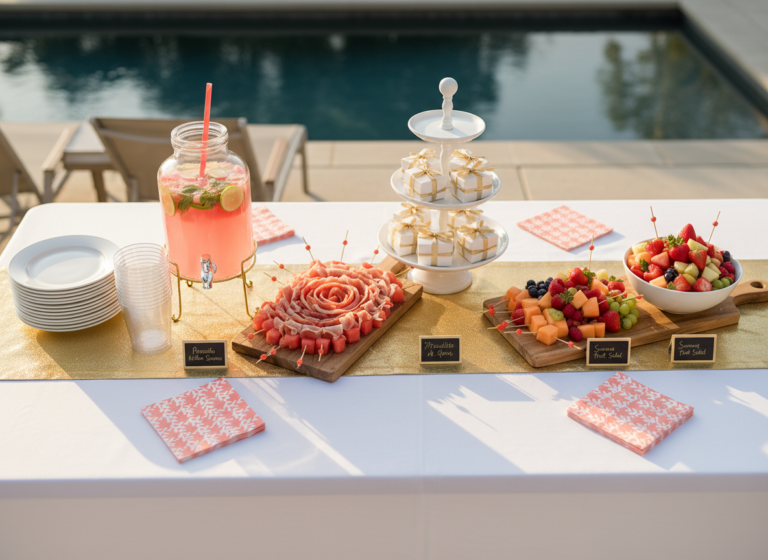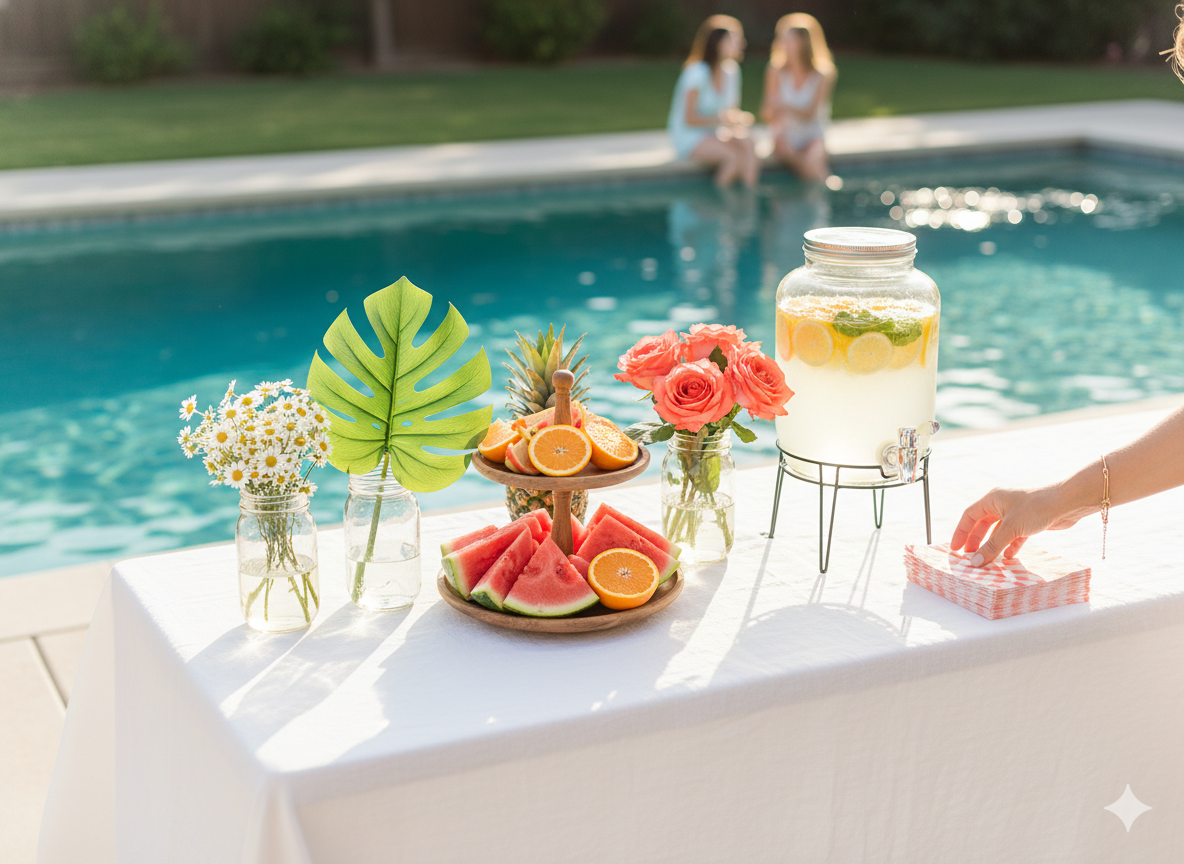
Effortless Pool Party Table Decorations That Look Amazing!
Why are pool party table decorations so important? Simply because the food table is the most looked-at surface at any pool party.
Not the pool. Not the welcome area. Not the string lights along the fence. The food table — because it’s where guests spend the most time standing still, and standing still is when people actually look at things.
Which means your food table is doing two jobs at once: serving the food, and it’s representing the party.
A table that looks good makes the whole afternoon feel more considered. A table that looks thrown together makes everything feel a little less intentional, regardless of how much effort went into everything else.
Fortunately, pool party table decorations don’t require a large budget, a background in event design, or hours of setup. It requires understanding which elements do the most work — and focusing your energy there.
The Foundation: Getting the Table Itself Right
Before any decoration goes on the table, the table itself needs to be right. Everything you layer on top is building on this foundation, and a weak foundation makes everything above it look worse.
Size and stability
Your food table needs to be large enough to hold everything without looking cramped, and stable enough that it doesn’t wobble when someone reaches across it.
A wobbly table is a food safety issue and a decoration nightmare — nothing stays arranged on a surface that moves.
If you’re using a folding table, check that the legs are fully locked before you set anything up. Place it on a level surface. Test it with your hands before you start decorating.
For a party of 20 guests, a 6-foot table (72 inches) is the practical minimum for a food spread. An 8-foot table gives you more breathing room and the ability to create proper zones.
Shade placement
Position your table in the shade wherever possible. This matters for food safety — nothing perishable should sit in direct summer sun — and it matters for the decorations. Fresh flowers wilt faster in direct sunlight. Paper goods fade. Ice melts. Candles are useless.
A table in a shaded spot also photographs better. Harsh direct sunlight creates unflattering shadows and washes out colour. Soft, diffused light from an overhead pergola, a large umbrella, or the shadow of the house makes everything look better.
The right height
Standard folding tables are 30 inches high, which is the right height for a standing food table. If you’re creating a lounge-style setup with lower surfaces, guests will need to crouch to reach the food, which nobody enjoys.
Keep food tables at standing height. Use lower surfaces — side tables, garden stools, small crates — for drink stations, dessert displays, or decorative elements that don’t require guests to reach into them.
The Tablecloth: Your Single Most Important Decision
If there is one thing worth spending money on for a pool party table, it is a good tablecloth. Everything on top of it will look better or worse depending on what it’s sitting on.
White or cream linen
This is the right choice for almost every pool party, every time. A white or cream tablecloth makes food look vibrant, makes props look intentional, makes cheap serveware look considered, and photographs beautifully in outdoor light.
It is also the most versatile option you can own — it works for every theme, every season, and every budget level of decoration layered on top of it.
A decent white linen-look tablecloth costs $8–$15 and will outlast years of parties. Buy one that’s slightly too long so it drapes over the edges — a tablecloth that barely reaches the edges looks like an afterthought.
Patterned tablecloths
A patterned tablecloth can work beautifully when it’s the deliberate foundation of a theme. A tropical leaf print for a luau, a red gingham for a Classic Americana party, a blue and white stripe for a nautical theme.
The risk is that a busy pattern competes with everything on top of it. If your food spread is colourful and varied — which pool party food usually is — a patterned tablecloth creates visual noise rather than cohesion.
The rule: if you use a patterned tablecloth, keep everything on top of it simple and coordinated. If you want to create a layered, styled spread, use a solid or white tablecloth.
Using a table runner
A table runner — a narrower strip of fabric or paper down the centre of the table — is a practical way to add colour or texture to a white tablecloth without committing to a fully patterned surface.
A linen runner in sage, coral, or natural jute costs $6–$12 and immediately makes a plain white tablecloth look styled. Add it on top of your main tablecloth, centred, with the ends hanging off the short sides of the table.
Height: The Element Most Hosts Forget
A flat table, with no height variations, looks uninspired regardless of how much money you spend. Height variation is what separates a styled table from a functional one.
Tiered stands
A tiered stand — bamboo, wood, or wire — is the single most efficient tool for adding height and visual interest to a food table.
Load it with food, decorations, or a mix of both, and it immediately creates the kind of layered, abundant look that takes real skill to achieve any other way.
A basic two or three-tier stand costs $12–$20 and is reusable indefinitely. If you host more than one or two parties per year, it pays for itself pretty soon.
DIY risers
You don’t need to buy anything to add height. A stack of books under the tablecloth creates a raised platform. An upturned bowl under a platter lifts it. A small wooden crate or a terracotta pot turned upside down works as a riser for a serving dish.
The books-under-the-tablecloth technique, in particular, is one of those things that looks completely intentional from the outside and costs nothing.
Varying container heights
When you’re arranging jars, glasses, and vessels on the table, choose containers in different heights and group them so the tallest is at the back, the shortest at the front. This creates a natural sense of depth and dimension, even without any risers.
Serveware: What to Use and What to Avoid Outdoors
Pool party serveware has a non-negotiable rule: no glass near the pool.
This is a safety requirement, not a style preference, and it applies to everything — glasses, bowls, platters, vases, and jars that are within reach of the pool area.
Melamine
The best material for outdoor pool party serveware. Melamine looks like ceramic from a distance, it’s lightweight, comes in beautiful colours and patterns, and it won’t shatter if dropped on a deck.
A set of melamine serving bowls and platters costs $20–$40 and will last for years of outdoor entertaining. This is one of the better investments for anyone who hosts pool parties regularly.
Wooden boards and trays
A wooden serving board or tray is one of the most versatile pieces of outdoor serveware you can own. Use it as a base for a charcuterie arrangement, as a tray for condiments and napkins, or as the foundation for your centrepiece cluster.
Wood is naturally beautiful; it doesn’t shatter, it ages well, and it looks appropriate at an outdoor party in a way that plastic never quite does.
Coordinated paper goods
For plates, cups, and napkins, a coordinated set in your colour palette does more for the look of a table than almost any other single purchase. Go for two or three colours at most, in a simple pattern or solid.
Paper goods from specialty party supply stores look beautiful, but cost significantly more than the same coordinated set from Amazon or a dollar store. The quality difference is rarely visible to guests.
What to avoid
Glass serving dishes near the pool. Anything so heavy that reaching across the table risks pulling the tablecloth. Very tall, narrow vases that tip over easily. Candles in open flames on a windy day — use battery-operated alternatives instead.
💡 Planning a themed table? Splash Bash Pass pairs curated decoration lists — including serveware and table styling suggestions — with every one of its 40+ party themes. Explore themes →
The Drinks Station: Make It a Feature
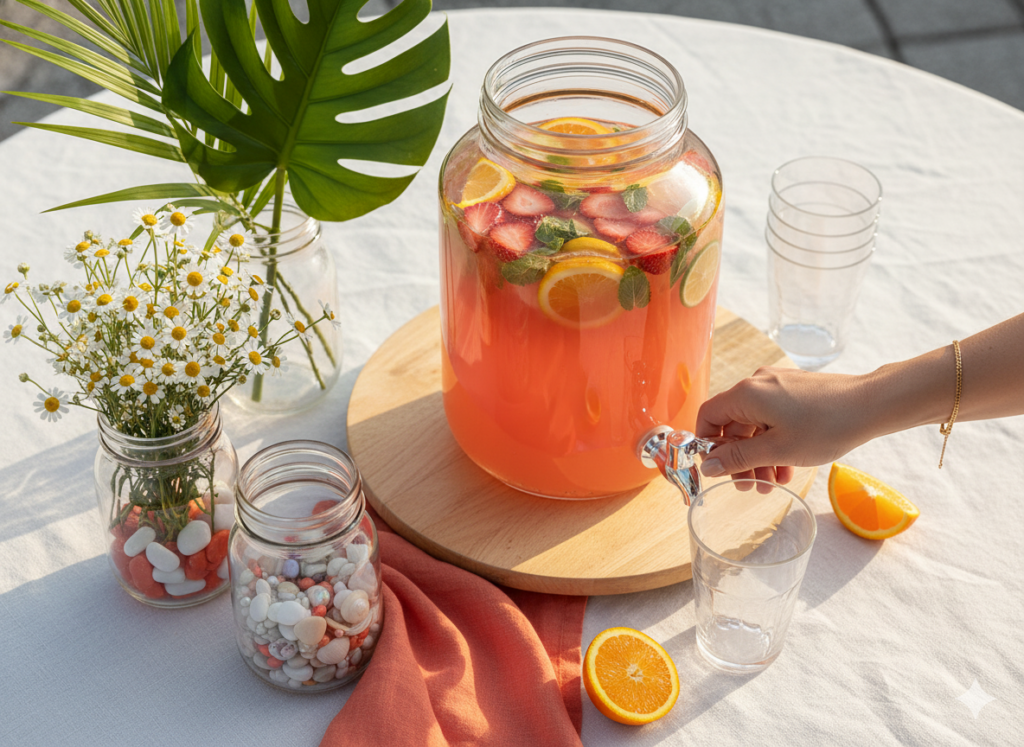
A drinks station deserves its own space on the table — or ideally, its own small side table — and its own decoration treatment. When it’s styled well, it becomes a centrepiece in its own right.
The drink dispenser as hero
A large glass or clear plastic drink dispenser filled with a visually appealing beverage is simultaneously functional and decorative. Lemonade with lemon slices and mint. Watermelon agua fresca. A coral-coloured punch with floating berries and lime.
Place it on a small wooden board or riser slightly elevated above the surrounding items. Add two or three mason jars of garnishes beside it — mint sprigs, citrus slices, paper straws in your colour palette — and the whole station looks intentional.
Labelling
Small handwritten labels or simple card tents in front of each drink and food item do two things: they’re practical for guests with dietary needs, and they make the table look significantly more styled.
A 3×5-inch folded card with the drink name written in marker costs nothing and communicates that you thought about the details.
The ice bucket
A galvanized metal ice bucket filled with canned drinks or bottled water adds visual interest, keeps drinks cold, and is appropriately casual for a pool party setting.
Group it with the drinks dispenser and a stack of cups, and you have a complete, self-serve drinks station that requires no management.
Food Table Layout: How to Arrange Everything
The arrangement of items on the table affects the look as much as the individual pieces themselves. A well-arranged table with simple props looks more stylish than a cluttered table with expensive ones.
The back-to-front principle
Place taller items at the back of the table, shorter items at the front. This ensures everything is visible from where guests are standing and creates a natural sense of depth and layering.
Grouping by category
Arrange food and drinks in logical groups — savoury together, sweet together, drinks at one end — with decorative elements anchoring each group rather than scattered randomly. Guests should be able to read the table at a glance and find what they want without hunting.
Leaving breathing room
Resist the urge to fill every inch of the table surface. White space — empty tablecloth visible between items — is what makes a table look styled rather than overcrowded.
A busy table looks like a buffet. A table with breathing room looks like a spread.
The 70/30 rule
Set out 70% of your food at the start and hold 30% back in the kitchen. Replenish every 45 to 60 minutes rather than letting items look depleted. A full, fresh-looking table at hour three looks significantly more considered than a half-empty one that peaked at the start.
Pool Party Table Decorations by Theme
Tropical Paradise
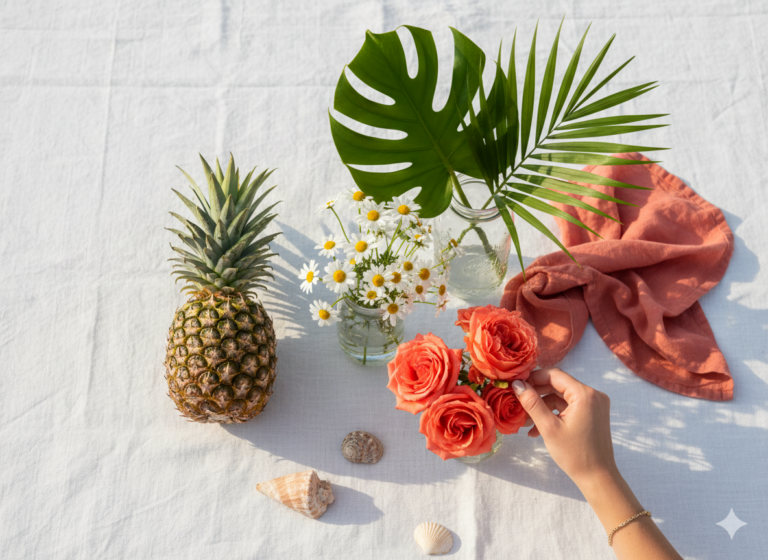
White linen tablecloth with a natural jute runner. Mason jar trio with bird of paradise stems and tropical leaves. A small pineapple as a prop. Melamine serveware in coral and white. A large lemonade dispenser with lime slices. Paper straws in coral and green.
Nautical Night
White and navy tablecloth or white linen with a navy runner. Three lanterns of varying heights on a rope-lined tray. A glass jar of sand and shells beside the centrepiece. White and navy coordinated paper goods. Galvanized metal ice bucket for drinks.
Greek Island
White linen with a terracotta linen runner. Terracotta pots filled with fresh herbs — rosemary, basil, thyme — as the centerpiece. Ceramic-look melamine serveware. Olive branch clippings as filler throughout. White and terracotta colour palette.
Classic Americana
Red gingham tablecloth or white linen with a red runner. A patriotic fruit arrangement — strawberries, blueberries, white melon — as the centerpiece. Mason jars of white daisies. Red, white, and blue coordinated paper goods. A small American flag or two in the centrepiece.
Midnight Moonlight
White linen with a silver or dark navy runner. Battery candles in crystal-effect holders on a mirrored tray as the centrepiece. Dark florals — deep purple or white roses with dark foliage. Silver or white metallic paper goods. Fairy lights strung above the table if the party runs into the evening.
The Setup Checklist
This is what a fully styled pool party table looks like when it’s done correctly. Work through it in order the evening before the party.
The tablecloth goes on first, pulled taut and draped evenly. Any risers or books go under it at this stage. Then the table runner, centred. Then the centerpiece arrangement is set in place before the food goes around it.
Serveware, boards, and trays go down next — empty, in their positions. Then, labels or card tents in front of each position. Then the drinks station is set up at one end. Paper goods — plates, napkins, cups — are stacked or fanned at the other.
Food goes out last, no more than 30 minutes before guests arrive for anything perishable.
Step back, look at the table from the angle guests will see it as they approach, and adjust anything that looks crowded or off-balance.
Then walk away and let the afternoon do the rest.
For the full decorating guide: Budget Pool Party Decorations That Will Wow Your Guests →
For centrepiece ideas specifically: The Best Pool Party Centerpiece Ideas for Every Budget→
For the full planning walkthrough: How to Plan a Pool Party: The Ultimate Step-by-Step Guide →
🐬 Let Marina Match Your Table to Your Theme
A beautifully styled table starts with a well-chosen theme — and Marina helps you build the whole party around it.
Meet Marina, your AI pool party specialist inside Splash Bash Pass.
🗓️ Guest list and RSVPs tracked in real time
💰 Budget tracking by category, planned vs actual
📣 Theme-matched invitations ready in seconds
📍 Top local vendors found near you via Google Maps
🛡️ Water Watcher assignments and safety checklists built in
☀️ Live weather monitoring with automatic backup plans
🎨 40+ curated themes with menus, décor, and music included
🪄 Paste your messy notes, and Marina organizes them instantly
Onboarding is completely free.