Pool Party Tournament Guide: Easy to Set Up Fun Formats
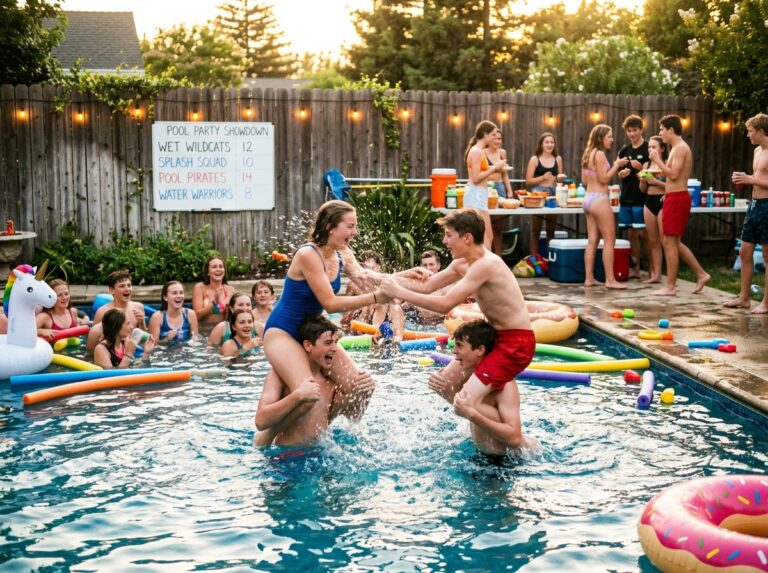
A Pool Party Tournament turns a casual sunny afternoon into unforgettable excitement. It’s not about winning—it’s about giving your guests something to cheer for.
The relay race, where the champions celebrated a little too loudly. The noodle jousting round where the scrawny teenager toppled three opponents in a row. The cannonball contest where your best friend’s kid made the biggest splash!
These are the stories guests retell at the next gathering. The tournament provides the structure—the bracket that transforms loose games into a narrative with stakes, a climax, and a finale.
Get Brooke’s Free Pool Party Checklist
8 stages · 75+ checkpoints · print & tick your way to the perfect party
And here’s the best part: a well‑run pool party tournament doesn’t demand complex planning or pricey gear. Just three easy steps:
- choosing the events,
- setting up the format,
- tracking the scores.
Nail those, and the competition runs itself for hours with minimal effort from you.
This guide lays out the complete framework: event selection, bracket styles, scoring systems, team setups, and the logistics that keep your Pool Party Tournament flowing smoothly from kickoff to medal ceremony.
📣 Splash Bash Pass includes an activity timeline and party planning guide that schedules your tournament, food service and key party moments so everything runs in the right order. Try it free →
The Tournament Structure Decision
Before you start inflating floaties or setting out the lemonade, pause to decide on the format of your Pool Party Tournament.
This choice is the backbone of the afternoon—it shapes team size, the number of events, how long the competition lasts, and even the narrative arc.
Think of it as choosing the recipe before you start cooking: once you know the format, everything else falls neatly into place.
Get Brooke’s Free Pool Party Checklist
8 stages · 75+ checkpoints · print & tick your way to the perfect party
1. Single Elimination
How It Works:
This is the simplest format. Each match produces one winner and one loser. Losers are out, winners advance. With eight teams, three rounds crown a champion; with four teams, two rounds are enough.
Best For:
- Smaller guest lists where you want a quick, decisive competition.
- Adults who thrive on clear outcomes and bragging rights.
- Parties where the tournament is just one slice of the afternoon, not the main course.
Limitations:
Teams eliminated early may find themselves with little to do during later rounds. In a pool setting, this isn’t as dire as it sounds—eliminated players can swim, sip iced tea, or cheer from the sidelines.
Still, the social dynamic shifts: half the crowd spectates while the other half competes.
Think of this as the “grilled hot dogs” of tournament formats—fast, familiar, and satisfying, but not meant to carry the whole meal.
2. Round Robin
How It Works:
Every team plays every other team. At the end, the team with the most wins takes first place.
Best For:
- Guests who value the experience of playing as much as the outcome.
- Mixed‑age or mixed‑ability groups where everyone deserves plenty of turns.
- Parties where the tournament is the centerpiece, filling two to three hours of active competition.
Limitations:
Round robin takes longer than elimination. For six teams, fifteen matches are required. That’s a lot of splashing, cheering, and scorekeeping.
It’s perfect if the tournament is the main event, but not ideal if you’ve also planned a barbecue, karaoke, or fireworks later in the day.
This is the “potluck dinner” of formats—everyone brings something to the table, everyone gets a taste, and the joy is in the variety.
3. Pool‑Into‑Knockout
How It Works:
This hybrid combines round robin’s inclusivity with elimination’s drama. Teams are divided into two groups. Each team plays every team in its group. The top two from each group advance to the semi‑finals, then the finals.
Best For:
- Six to ten teams.
- A two‑to‑three‑hour tournament window.
- Crowds where everyone should get multiple games before elimination begins.
Limitations:
It requires a bit more organization—keeping track of group standings, then shifting into knockout mode.
But the payoff is worth it: every team gets at least three matches, and the finale has the high‑stakes energy of a championship.
This is the “Thanksgiving dinner” of formats—everyone gets plenty of food before the drama of the pie contest at the end.
4. Time‑Based Tournament
How It Works:
Instead of wins and losses, teams accumulate points across timed events. Each event runs for a set duration, and the team with the most points scores tournament credit. All teams participate in every event, either simultaneously or in sequence.
Best For:
- Events where head‑to‑head matching is tricky, like relay races or diving challenges.
- Large guest counts where bracket management feels overwhelming.
- Crowds more interested in participation than precise rankings.
Limitations:
This format requires careful scorekeeping and a watchful eye on the clock. It’s less about dramatic eliminations and more about steady accumulation.
That makes it perfect for families, neighborhood gatherings, or parties where the vibe is “everyone plays, everyone laughs.”
This is the “buffet brunch” of formats—everyone gets to sample everything, and the fun is in piling your plate high.
Event Selection
When planning a Pool Party Tournament, the events themselves are the heartbeat of the afternoon. To keep things balanced, choose three distinct formats: a speed event, a skill event, and a physical challenge event.
This ensures no single athletic ability dominates—your fastest swimmer won’t necessarily win the skill round, and your most powerful cannonballer won’t automatically triumph in the relay. Variety keeps the competition fair, fun, and memorable.
Speed Events
The Freestyle Relay
Teams of three or four line up poolside. Each swimmer races one length, tagging the next teammate at the wall. The first team to finish all lengths wins. It’s the most fundamental speed event, and the atmosphere it creates—cheers, splashes, frantic tagging—is electric.
The Noodle Relay
Here, balance matters more than raw speed. Each competitor must ride a pool noodle (seated, noodle between the legs) from one end of the pool to the other and back.
Falling off means restarting that leg. This format levels the playing field, making strong swimmers no more advantaged than those with better balance and technique.
The Kickboard Relay
Competitors swim one length using only a kickboard—arms flat across the board, legs doing all the work. By removing the arm advantage, this event makes the race more equitable for mixed‑ability groups. It’s slower, but the suspense builds as every kick counts.
Skill Events
The Diving Ring Treasure Hunt
Weighted rings in gold (5 points), silver (3 points), and bronze (1 point) are scattered across the pool floor. Each team sends two divers with sixty seconds to collect as many as possible.
Strategy matters: chase the gold in the deep end or scoop up multiple bronze in the shallow? The total points decide the winner.
The Accuracy Cannonball
A floating hoop—made from a bent pool noodle—marks the target. Each team sends one representative, who gets three attempts. Landing within six feet earns 3 points, within three feet earns 5, and going through the hoop scores 10.
It’s part skill, part spectacle, and always a crowd‑pleaser.
The Ball Shoot
A floating basketball hoop sits at the pool’s edge. Each team member gets three throws from a designated spot in the water. Standard scoring applies: 2 points per basket.
This event produces the most sustained spectator engagement—every shot is a dramatic moment, every splash a gasp.
Physical Challenge Events
Noodle Jousting
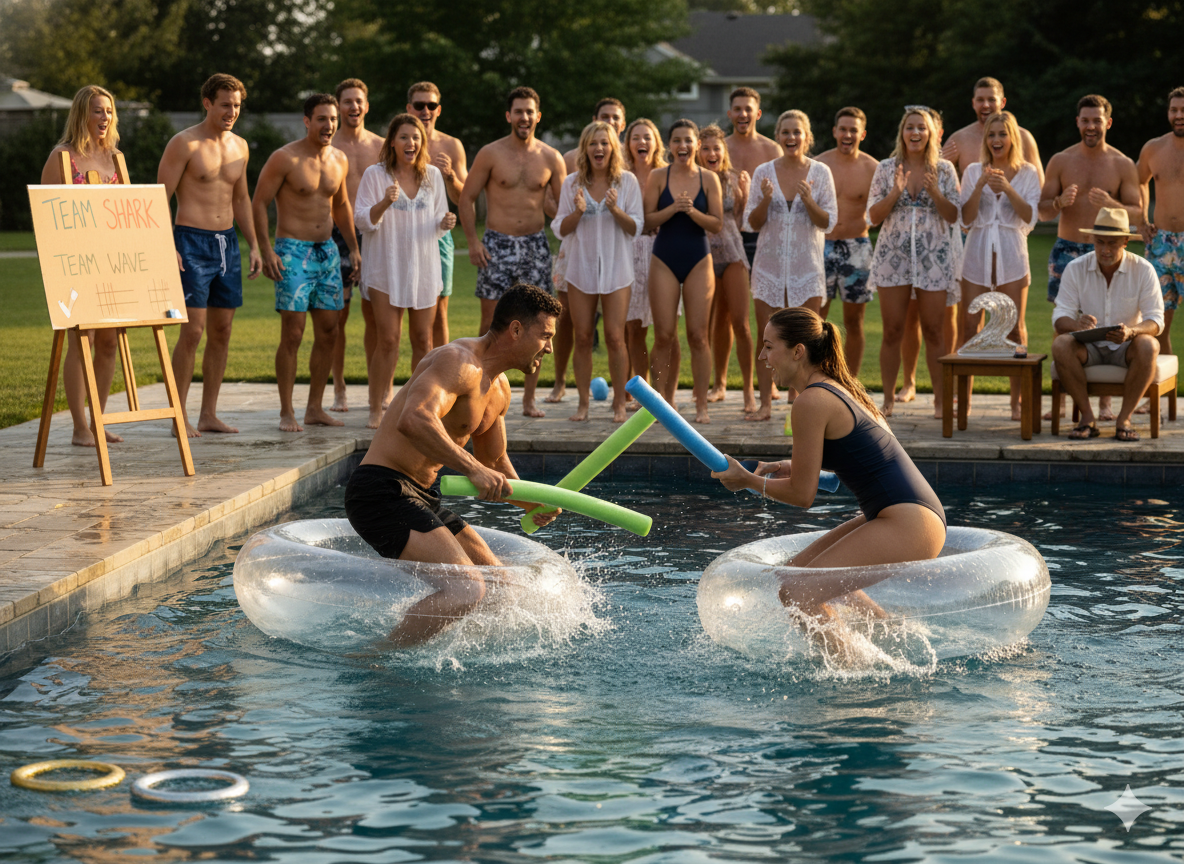
Two competitors face off on matching floats—wide enough to support an adult without tipping—armed with pool noodles. First to knock the other into the water wins. Teams send players in sequence, ladder‑style.
It’s playful, dramatic, and requires just enough balance to keep everyone laughing.
The Watermelon Push
One competitor per team must push a watermelon from one end of the pool to the other using only their nose or forehead. No hands allowed. It’s universally difficult, endlessly hilarious, and levels the playing field—no one has a natural advantage here.
The Endurance Float
Each team sends one competitor to float on their back in a star position—arms and legs still, no movement allowed. The last person still floating wins. It’s slow, tense, and oddly mesmerizing, with bursts of laughter when someone inevitably breaks position.
Team Construction
How teams are formed determines whether the tournament feels competitive and fair or lopsided and frustrating. Think of it like arranging seats at a dinner party—the mix matters as much as the menu.
Random Draw
How It Works:
Names are drawn from a hat at the start. Teams form on the spot, with no planning.
Best For:
- Ensuring fairness and eliminating bias.
- Encouraging social mixing—strangers end up on the same team, sparking new conversations.
- Parties where the social value of cross‑group bonding matters as much as the competition.
Limitations:
Randomness can produce uneven teams, but the surprise element often outweighs imbalance. Guests tend to embrace the fun of chance.
Captains Pick
How It Works:
Two or three designated captains take turns selecting team members from the pool of guests.
Best For:
- Groups of close friends who are comfortable with playful competition.
- Parties where competitiveness is part of the fun.
Limitations:
This format can make slower‑selected guests feel conspicuous. It’s not ideal for mixed‑acquaintance crowds where sensitivity matters.
Pre‑Balanced Assignment
How It Works:
The host creates teams in advance, balancing for swimming ability, age, and personality.
Best For:
- Hosts who know their guests well enough to make fair assessments.
- Preventing the common imbalance of all strong swimmers landing on one team.
Limitations:
Requires effort and insight from the host. Misjudgments can still happen, but the intention is to keep the competition engaging for everyone.
Mixed‑Age Pairing
How It Works:
Each team must include at least one adult and one child, regardless of team size.
Best For:
- Family‑oriented tournaments.
- Creating warm, cross‑generational moments—adults cheering for kids, kids celebrating adult victories.
Limitations:
Requires enough children and adults to balance teams. Works best in family‑heavy gatherings.
The Scoring System
A visible scoreboard is the glue that holds the tournament together. Accuracy isn’t the point—visibility is. Guests need to see the score to stay invested, even between events.
The Physical Scoreboard
How It Works:
Use a whiteboard, chalkboard, or even a large piece of cardboard with team names and tally marks. Place it where it’s visible from both the pool and the deck seating area. Update after every event.
Best For:
- Keeping the tournament present in guests’ minds.
- Adding a touch of drama as scores climb.
Limitations:
Requires someone to update consistently. Accuracy can be approximate, but that rarely dampens the fun.
Team Names
How It Works:
Assign names at the formation stage. Skip the bland “Team 1” and “Team 2.” Go for playful identities like “The Blue Noodles” or “Team Flamingo.”
Best For:
- Building team spirit and identity.
- Encouraging guests to cheer with more enthusiasm.
Limitations:
Requires a little creativity, but the payoff is worth it.
Point Values
How It Works:
Keep scoring simple: 3 points for first place, 2 for second, 1 for third. No complicated formulas.
Best For:
- Quick calculations by anyone watching.
- Maintaining momentum without bogging down in math.
Limitations:
Simplified scoring may not capture every nuance, but clarity beats complexity at a party.
The Tiebreaker
How It Works:
Define the rule before the tournament begins. Options include a sudden‑death relay, a one‑round noodle joust, or a single accuracy cannonball attempt.
Best For:
- Preventing arguments when ties occur.
- Turning tension into excitement rather than negotiation.
Limitations:
Requires foresight, but avoids awkward disputes mid‑party.
📣 Splash Bash Pass builds your complete party timeline — so the tournament schedule, food service and key moments all align without anything running at the same time as something else. Plan your schedule →
The Run of Events
A well‑sequenced tournament runs its events in a deliberate order that manages group energy across the full competition window.
Opening Speed Event
How It Works:
Begin with a high‑energy race such as the freestyle relay or noodle relay. This sets the competitive tone early, gets everyone into the water, and produces immediate excitement. The crowd naturally gathers around the relay, cheering loudly as the first points are scored.
Best For:
- Establishing atmosphere quickly.
- Drawing in spectators from the start.
- Creating momentum that carries into later events.
Limitations:
High energy can be exhausting if sustained too long, so this event works best as an opener.
Skill Event
How It Works:
Follow the relay with a technical challenge like the diving ring treasure hunt. After the adrenaline of the race, the focus shifts to precision and strategy. Divers hunt for rings of varying point values, and the crowd leans in to watch the choices unfold.
Best For:
- Balancing energy levels after a fast start.
- Highlighting individual skill within a team framework.
- Keeping spectators engaged with suspense rather than speed.
Limitations:
Requires clear rules and time limits to prevent dragging on.
Mid‑Tournament Physical Challenge
How It Works:
Insert a physical challenge such as noodle jousting or the watermelon push. These events produce the funniest moments of the day and reset any flagging energy. By this point, scores matter, so each round carries stakes that heighten the laughter and drama.
Best For:
- Re‑energizing the crowd mid‑afternoon.
- Creating memorable highlights.
- Building anticipation for the final rounds.
Limitations:
Needs proper equipment and supervision to keep the fun safe.
Closing Crowd‑Participation Event
How It Works:
End with an event that invites dramatic reactions, like the cannonball contest or ball shoot. Each attempt is a distinct moment—every splash or shot earns cheers. The finale should feel like a crescendo, with escalating energy that leaves the crowd buzzing.
Best For:
- Providing a strong finish.
- Giving spectators repeated opportunities to react.
- Cementing the tournament’s narrative arc.
Limitations:
Requires clear judging criteria to avoid disputes.
Total Event Count
Four to five events is the sweet spot for a two‑ to three‑hour tournament. Fewer than four feels abbreviated; more than five risks fatigue before the finale.
The Medal Ceremony
A tournament without a ceremony is a competition without closure. The ceremony need not be elaborate, but it should be specific and slightly ridiculous in the right ways.
Team Awards
How It Works:
Provide medals or prizes for the winning team. These can be toy store medals, a dollar‑store trophy, or a printed certificate. The object matters less than the act of presenting it in front of the full crowd.
Best For:
- Giving the competition a satisfying conclusion.
- Creating a photo‑worthy moment.
Limitations:
Requires a small amount of preparation in advance.
Individual Recognition
How It Works:
Offer a prize for the most memorable individual moment—whether it’s the most spectacular cannonball, the biggest jousting upset, or the most determined watermelon push. This award is usually obvious and earns the loudest reaction.
Best For:
- Highlighting standout performances.
- Ensuring every guest feels the competition was noticed.
Limitations:
Should be kept lighthearted to avoid hurt feelings.
Host’s Words
How It Works:
Keep remarks brief—thirty seconds is enough. Mention one specific moment that surprised everyone, such as an unexpected joust victory. Specificity shows the host was watching and that the competition mattered.
Best For:
- Personalizing the ceremony.
- Reinforcing the shared experience.
Limitations:
Generic comments dilute the impact; specificity is key.
Timing and Flow Management
The most common problem is events running long and collapsing into a single endless activity. Two decisions prevent this.
Time Limits
How It Works:
Set time limits per event, not just per round. If the diving ring event is scheduled for fifteen minutes, it ends at fifteen minutes regardless of the number of rounds completed. Announce limits clearly at the start.
Best For:
- Keeping the schedule intact.
- Preventing fatigue.
Limitations:
Requires discipline to enforce.
Dedicated Scorekeeper
How It Works:
Assign one non‑playing scorekeeper. This person tracks scores, manages transitions, and keeps pace. They do not compete—their role is operational continuity. Brief them before the tournament begins.
Best For:
- Ensuring smooth flow.
- Allowing the host to participate without losing control.
Limitations:
Requires a willing volunteer.
Safety in a Competitive Context
Competitive pool games bring more intensity than casual swimming. A few specific safety rules apply.
Water Watcher
How It Works:
During noodle jousting or other physical challenges, assign a water watcher whose sole job is to monitor the pool surface. Spectators often focus only on competitors, creating tunnel vision. The watcher must resist this and scan the entire pool.
Best For:
- Preventing unnoticed accidents.
- Maintaining safety during high‑energy events.
Limitations:
Requires vigilance and discipline.
Entry Rules
How It Works:
No head‑first entries. Cannonball contests are feet‑first, and relays start with push‑offs from the wall. State this rule explicitly at the start.
Best For:
- Reducing risk of injury.
- Keeping competition safe for all ages.
Limitations:
Needs clear enforcement.
Depth Awareness
How It Works:
Confirm relay courses are appropriate for all swimmers. Avoid requiring lengths in the deep end if any competitor is uncomfortable there.
Best For:
- Ensuring inclusivity.
- Preventing panic or accidents.
Limitations:
May restrict course design, but safety outweighs complexity.
For the complete safety framework: Pool Party Safety Tips Every Host Needs to Know →
The Tournament That Made the Afternoon
The pool party tournament that lingers in memory isn’t the one with the longest schedule or the fanciest scoreboard. It’s the one where something wildly unexpected happened—something nobody could have scripted.
The noodle joust that stretched into three rounds between two guests who had never met before. The child who nailed the accuracy cannonball and outscored a dozen adults with one perfect splash. The team that clawed back from three points down to snatch victory on the final diving ring.
These are the moments that define the day. The bracket, the scoreboard, the event sequence—they’re just the frame.
What fills it is the people, on this particular afternoon, competing for a toy medal while a crowd cheers for outcomes no one planned.
That’s the magic: the surprise, the laughter, and the stories that will be retold at every pool party that follows.
For the individual games that work outside the tournament format, the pool party games for adults guide covers every in-pool and on-deck option.
For the children’s tournament-specific framework, the pool party games for kids guide covers the age-calibrated version of every event in this guide.
🏆 Let Marina Schedule Your Pool Party Tournament
Activity timeline, tournament bracket, event sequence, and a complete party plan — Splash Bash Pass builds the full tournament schedule around your guest count and party duration so every event runs at the right time.
Meet Marina, your AI pool party specialist inside Splash Bash Pass.
🗓️ Guest list and RSVPs tracked in real time
💰 Budget tracking by category, planned vs actual
📣 Theme-matched invitations ready in seconds
📍 Top local vendors found near you via Google Maps
🛡️ Water Watcher assignments and safety checklists built in
☀️ Live weather monitoring with automatic backup plans
🎨 40+ curated themes with menus, décor, and music included
🪄 Paste your messy notes, and Marina organises them instantly
Onboarding is completely free.