Pool Party Food for a Crowd: The Ultimate “No Stress” Guide
To be honest, cooking, or even ordering pool party food for a crowd, can be quite challenging.
It is not just about more of the same food. You need a completely different approach. The formats that work for twelve guests — individual plated servings, a few carefully arranged boards, a single drink dispenser — start to break down at thirty guests and collapse entirely at fifty.
Get Brooke’s Free Pool Party Checklist
8 stages · 75+ checkpoints · print & tick your way to the perfect party
Queue formation at the food table. Shortage of serving spoons. Dishes that run out before the second wave of hungry guests arrives. Ice that melts before the afternoon is half done.
The hosts who pull off pool party food for a crowd successfully are not the ones who made better food. They are the ones who chose the right formats — formats designed to serve a crowd efficiently without requiring the host to be actively managing the food station all afternoon.
This is a logistics article as much as a food article. The recipes matter. The quantities matter. But the format decisions — self-serve versus plated, cold versus warm, batch dispensed versus individually prepared — are what determine the success.
This guide covers everything you need:
- the format decisions that determine whether large-scale pool party food works,
- the specific dishes that scale to a crowd without losing quality,
- the quantity calculations that prevent running out,
- the setup decisions that prevent queue formation and table congestion,
- and the preparation timeline that keeps the week before the party manageable
Here is the large pool party food framework worth planning from.
📣 Splash Bash Pass calculates your complete food quantities for any guest count and builds a shopping list and prep timeline around your party date. Try it free →
“This post contains affiliate links, and I will be compensated if you make a purchase after clicking on my links.”
The Format Decisions That Matter Most
Self-Serve Over Everything Else
For a pool party with more than twenty guests, self-serve is not a preference — it is a requirement.
A host who is actively serving food at a pool party is not at the party. They are behind the food table, managing spoons and refills while their guests are in the pool and at the bar.
Self-serve formats move the service responsibility from the host to the guest without any loss of quality — and often with a gain, because guests take exactly what they want at the pace they want it.
Every large pool party food decision should start with the question: Can this be set up so guests serve themselves completely independently? If the answer is no, the dish needs to be rethought.
Batch Formats Over Individual Portions
Large pool parties need food that scales in batches rather than in individual portions. A dish that requires twenty minutes of preparation per serving does not belong at a party for fifty people.
A dish that is made in a single large batch and then served throughout the afternoon belongs everywhere.
Slow-cooked pulled pork. A large pot of chili. A baked tray of sliders. A massive bowl of pasta salad. These formats scale without increasing the work proportionally — making fifty portions requires barely more effort than making twenty.
Hot Holding vs Active Cooking
For a crowd, warm food needs to be in a holding vessel — a slow cooker, a chafing dish, a covered foil tray in a warm oven — rather than actively cooked to order.
Active cooking at a pool party for a large crowd means the cook is at the grill or stove continuously rather than with guests.
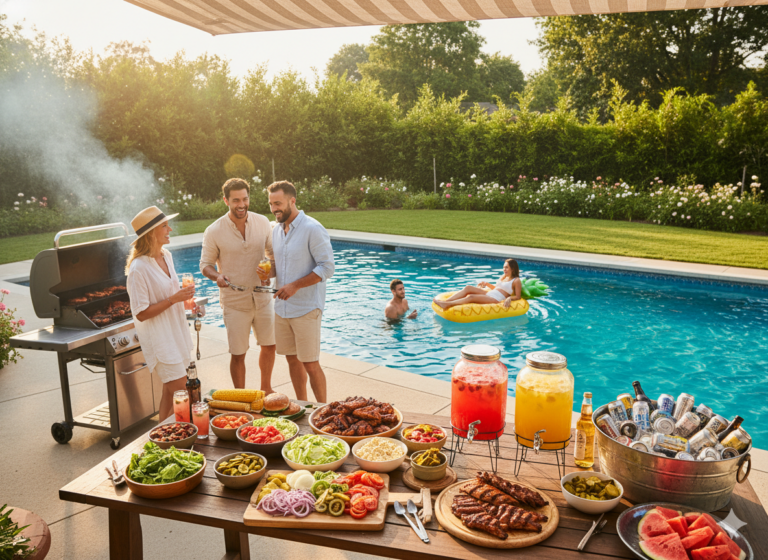
The one exception is a staffed grill station where the grilling is the entertainment — guests watching the grill, smelling the food, gathering around it. This format works at a BBQ-themed pool party specifically because the grill is an attraction rather than a service point.
For all other warm food: batch cook, hold warm, serve from a vessel that maintains temperature independently.
Get Brooke’s Free Pool Party Checklist
8 stages · 75+ checkpoints · print & tick your way to the perfect party
Multiple Service Points Over One Table
A single food table at a party of fifty creates a queue. Two service points — even if they hold the same food — halve the queue length. Three service points break the congestion pattern entirely.
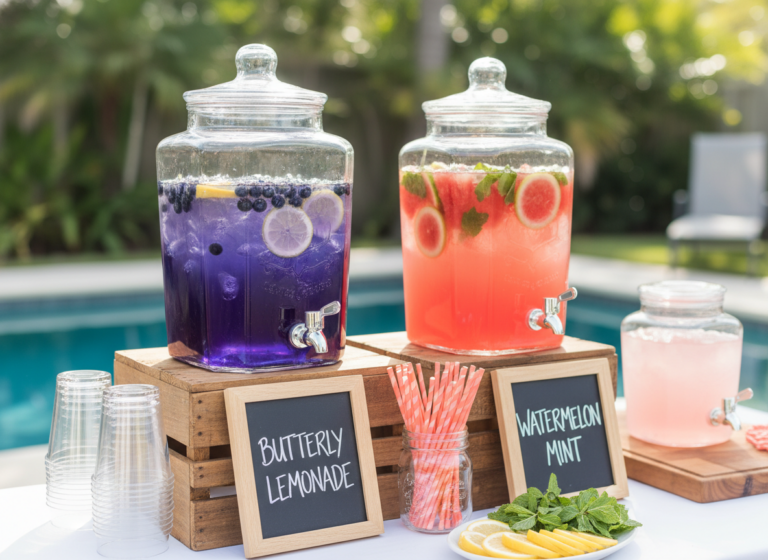
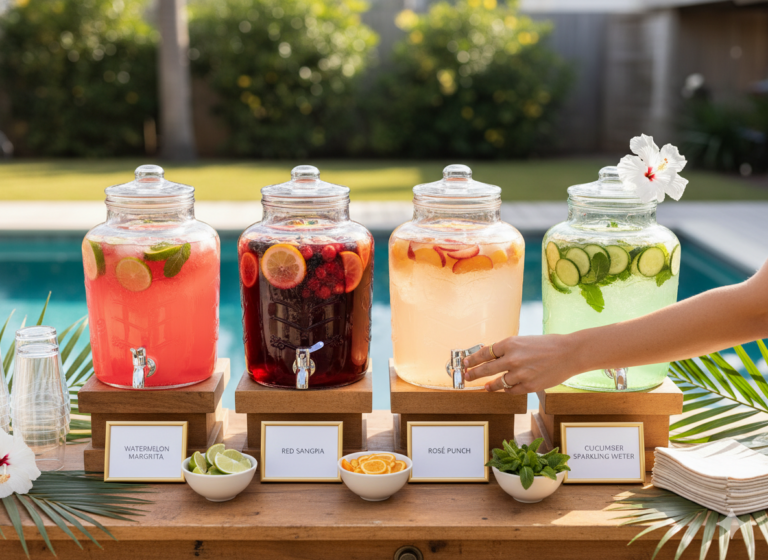
This does not require three separate food tables. It can be as simple as two drink dispensers at opposite ends of the party space, a second cooler of cold drinks near the pool, and a satellite snack station near the lounge area away from the main food table.
Distributing the food service across the space distributes the guest movement with it.
The Dishes That Scale
Pulled Pork Sliders — The Anchor Dish for a Crowd
Slow-cooked pulled pork is the most reliably crowd-pleasing large-batch main dish for a pool party.
It requires minimal day-of effort, scales to any quantity without loss of quality, holds warm in a slow cooker for the full duration of the party, and accommodates the self-serve format completely.
How to scale it: One shoulder of pork (approximately 4-5 lbs bone-in weight) feeds twelve to fourteen guests in slider format. For thirty guests, you need two shoulders. For fifty, increase it to four shoulders.
The slow cooker approach: Season generously with a dry rub (paprika, brown sugar, garlic powder, cumin, salt, black pepper), slow cook on low for eight to ten hours, and shred directly in the cooker. Keep on warm setting throughout the party.
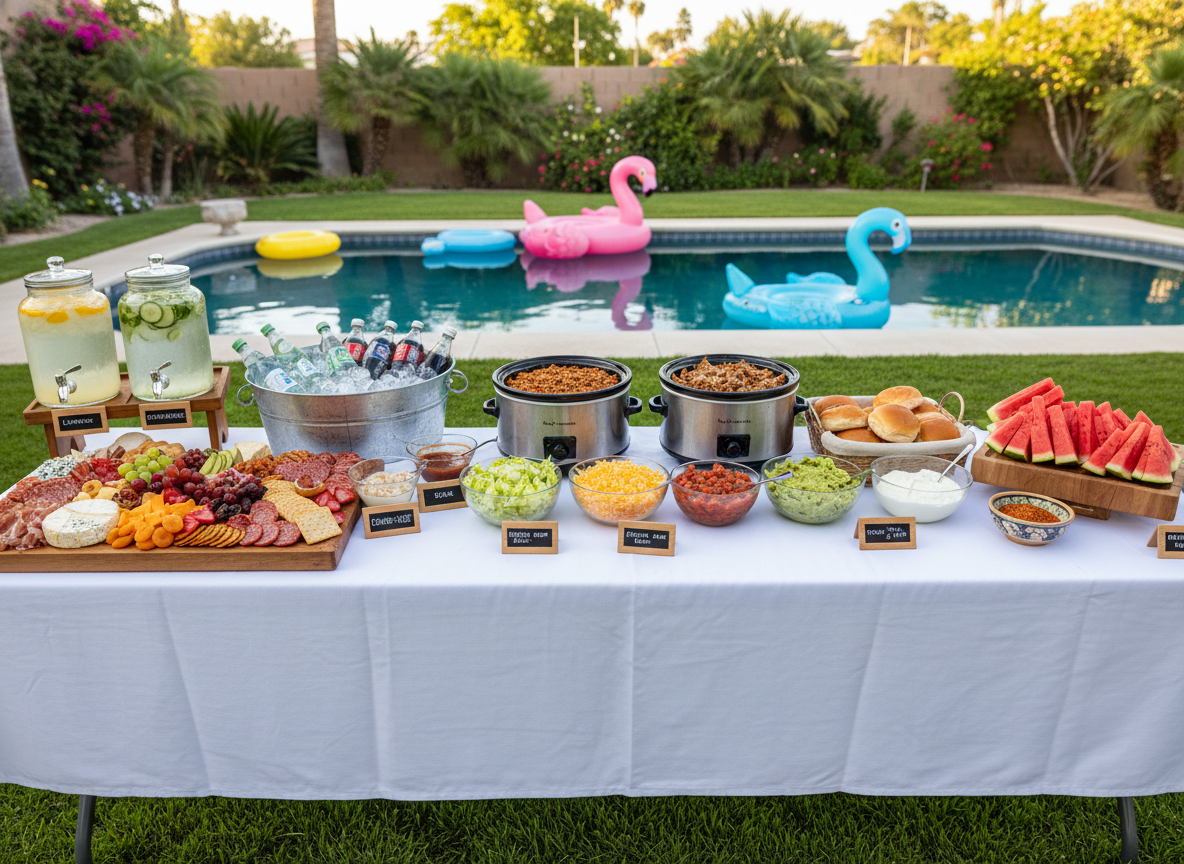
The self-serve station: A slider bun basket, a pulled pork slow cooker with tongs, small labeled bowls of toppings — coleslaw, pickles, barbecue sauce, hot sauce, sliced jalapeños — and a small stack of plates. Each element is accessible without the host’s involvement.
Day-before option: Pulled pork is better made the day before and refrigerated overnight. The fat solidifies, and the flavors concentrate. Reheat in the slow cooker for two hours before service.
Taco Bar
The self-serve format works for every demographic, every dietary requirement, and every party size.
Set out all components in labeled bowls and let guests build their own. The result is faster service than any plated format, zero waste because guests take only what they want.
This is a food station that handles vegetarians, meat-eaters, and every variation in between through a single setup.
What to put out: Seasoned ground beef and/or pulled chicken in slow cookers. Shredded cheese. Shredded lettuce. Diced tomato. Sour cream. Guacamole. Pickled jalapeños. Salsa in mild, medium, and hot. Corn and flour tortillas. Lime wedges.
How to scale: For a standard taco bar, plan for three tacos per adult guest and two per child. For a crowd where tacos are the main, scale to four per adult. For a crowd where tacos are one station among several, three per adult.
The label system: Label every bowl and component clearly. A taco bar without labels requires guests to ask what everything is, which creates conversation at the food station that slows service. Labels eliminate the question.
Sheet Pan Sliders
Twelve slider buns per sheet tray, filled with your choice — pulled pork, pulled chicken, classic beef patty, BBQ jackfruit for vegetarians — covered with a second sheet tray and baked for fifteen to twenty minutes until the buns are toasted and the filling is hot through.
Sheet pan sliders are made in batches of twelve. For sixty guests planning on two sliders each, that is ten sheet pans. Each pan takes fifteen minutes in the oven.
Stagger the batches so fresh sliders arrive at the table in waves rather than all at once — a wave of twelve fresh hot sliders every twenty minutes keeps the food table active and signals to guests that more is coming.
The make-ahead dimension: Assemble the sliders fully — buns cut, filling added, cheese placed, top bun on — wrap each tray in cling film and refrigerate. On the day, unwrap and bake. Day-of preparation time is approximately five minutes per tray.
Giant Charcuterie and Grazing Table
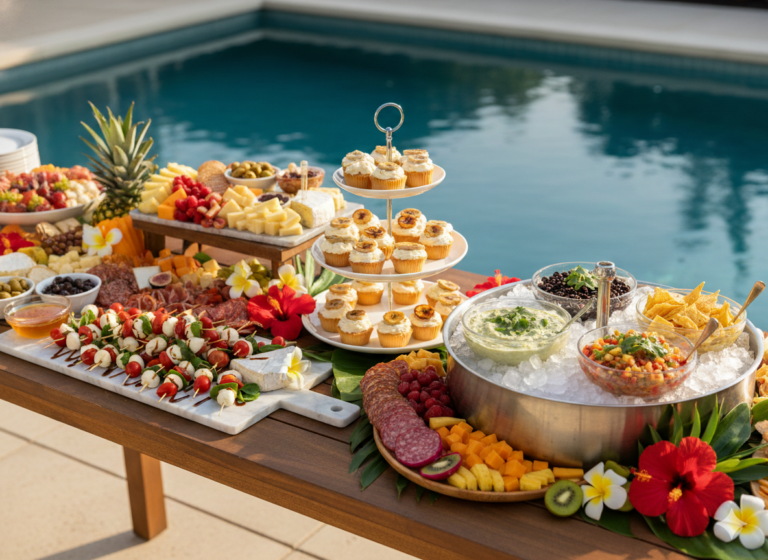
A large grazing table — charcuterie, cheeses, crackers, olives, dips, fresh fruit and vegetables — is the most visually impressive and least logistically demanding food option for a large pool party.
It requires no cooking, no temperature management (within reason), no active service, and no replenishment for the first two hours.
Scaling up: A grazing table for fifty guests is not fifty times the effort of a grazing table for ten. It is the same assembly process repeated across a larger surface. The work is in the sourcing — buying the right quantities — and the presentation.
Quantity guide for grazing as the primary arrival food: For a charcuterie spread, plan on 3½ to 5 ounces of meats per guest and 2 to 3 ounces of cheese per guest, plus a generous supply of crackers, fruit, and other accompaniments.
For a party of fifty, that works out to roughly 13 to 17 pounds of charcuterie and 6 to 9 pounds of cheese across the table.
The visual approach at scale: Larger tables require larger visual elements. Individual small bowls disappear on a large surface. Use large ceramic bowls, full fruit bowls that pile above the rim, generous arrangements that fill the surface rather than dot it.
A grazing table at scale should look abundant — not sparse and carefully arranged, but actually overflowing.
Large Batch Pasta Salad with Vinaigrette
The most practical cold side dish at scale. Made the day before in large batches, holds well for twenty-four hours, requires no temperature management during the party, and is universally liked across every age group.
Scaling: One pound of dried pasta yields about three pounds of cooked pasta salad. For fifty guests as a side, plan on 5 ounces of finished salad per person — roughly 5½ pounds total. That amount requires about 1¾ pounds of dried pasta.
Use the vinaigrette version (as covered in the side dishes article) rather than a mayonnaise-based dressing. The vinaigrette version holds at room temperature for longer without deteriorating.
Make-ahead timing: Make two to three days in advance. The dressing penetrates the pasta more deeply with time, improving the flavor. Add fresh basil or fresh herbs on the day immediately before serving.
Corn on the Cob — Self-Serve Station
Boiled or grilled corn held in a covered vessel and served from a self-serve station is the most crowd-friendly warm side dish available. Guests take one, dress it themselves from the butter and seasoning options provided, and move on.
Scaling: Plan one to one and a half cobs per guest. For fifty guests, that is fifty to seventy-five cobs. A very large stockpot or two medium stockpots handles this quantity.
Holding: Cooked corn stays warm wrapped in individual foil pieces for forty-five minutes. A large cooler lined with several layers of towels and filled with the foil-wrapped corn holds its temperature for up to two hours.
This is the easiest warm-food holding solution available at scale.
The butter station: Rather than one butter dish that creates a bottleneck, set out three or four small labeled butter dishes — plain, garlic herb, chili lime, parmesan — at different points along the service area. Each station is independent, and the corn station serves itself.
Large Format Salad — The Crowd Version
A large salad for a crowd needs to hold its texture and visual quality for two to three hours of outdoor service.
The salads that hold best at scale: corn and black bean (covered in the side dishes article), grain-based salads (quinoa, farro, barley), and legume-based salads (chickpea, white bean, lentil).
What does not hold: any leafy green salad, any salad with cut avocado, any salad with dressed fresh tomatoes.
Scaling a corn and black bean salad for fifty: Approximately six to eight cans of corn, six cans of black beans, four red peppers, one large red onion, two bunches of coriander, and a large batch of lime and cumin dressing.
Mix the day before, dress the day before, and serve directly from the refrigerator container.
Watermelon — The Simplest Crowd Food
Three to four whole watermelons cut into wedges and arranged on a long board or wooden tray is the single easiest crowd-scale food decision available for a summer pool party. No recipe. No preparation beyond cutting.
No holding required. And it is the food guests reach for most consistently throughout the afternoon at a hot outdoor party.
Scaling: One large watermelon (15-20 lbs) yields approximately forty medium wedges. For fifty guests, two large watermelons provide enough for the full afternoon with likely leftovers.
Presentation at scale: Line the wedges in a row along a long wooden board. Add a small bowl of Tajín or sea salt on the side. A second board at a second service point eliminates the queue that forms when the first board is the only option.
Arranging pool party food for a crowd is never easy. Enlist Marina, your AI pool party specialist inside Splash Bash Pass. She will help you at every stage.
📣 Splash Bash Pass calculates your complete food quantities for any guest count and builds a shopping list and prep timeline around your party date. Try it free →
Pool Party Food for a Crowd: Quantity Calculations
The most common large pool party food failure is running out. These calculations are designed to prevent it.
General rule: Plan for twenty percent more than the calculation suggests. The excess is easily managed — leftover food. The shortfall is not manageable once it occurs.
For a standard pool party with one main, two sides, and grazing:
| Guest count | Pulled pork (raw weight) | Taco portions | Pasta salad (cooked) | Watermelon |
|---|---|---|---|---|
| 20 guests | 3¼ lb | 60 tacos | 6½ lb | 1 large |
| 30 guests | 5½ lb | 90 tacos | 10 lb | 1½ large |
| 50 guests | 9 lb | 150 tacos | 16½ lb | 2½ large |
| 75 guests | 13 lb | 225 tacos | 24 lb | 4 large |
Drinks at scale: Plan on 16-18 ounces of liquid per person per hour across all drink types — water, cocktails, non‑alcoholic punch, beer, wine. A three‑hour party for fifty guests requires about 20 gallons total.
That’s more than most hosts expect, and it’s the number one reason parties run short on drinks rather than food.
Ice: Figure 1 pound of ice per person per hour. For fifty guests over three hours, that’s 150 pounds of ice. It sounds like a mountain, and it is. Buy it.
Set Up Decisions That Prevent Problems
Separate the Food and Drinks
Combining the food table and the drink station in one location creates a permanent bottleneck at the busiest point in the party. Separate them by at least ten feet and direct guests clearly to each.
At a party of fifty, a combined food-and-drink station means a constant ten-person queue at the one location. Separated stations distribute the traffic, and the queue is short and acceptable.

Never use glass cups at a pool party — it is a real safety risk, and most people don’t realise until something breaks. I used to recommend clear acrylic cups, until I discovered Top Cup. Aluminum chills instantly, it doesn’t shatter, is reusable, and honestly it looks better than anything plastic I’ve ever put on a drinks table.
Label Everything
Every dish. Every component. Every container. A label takes thirty seconds.
It eliminates the moment where a guest is standing at the food table for forty-five seconds trying to figure out the contents of a bowl before serving themselves. Forty-five seconds per person per dish, multiplied by fifty guests, equals severe congestion.
For dietary restriction awareness: label dishes that contain the eight common allergens (nuts, dairy, eggs, wheat, soy, shellfish, fish, sesame) and mark clearly which dishes are vegetarian or vegan.
This is especially important at a large party where the host cannot be at the food station to answer every question.
Stagger the Food Service
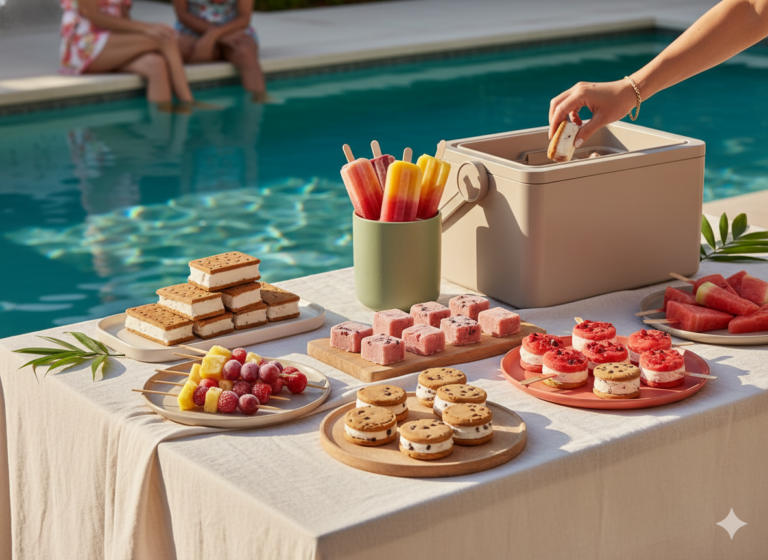
Do not put all the food out at once. A grazing table on arrival. The main food station opens at the ninety-minute mark. A dessert table is revealed later in the afternoon.
Staggering food service creates natural activity points in the party’s timeline — guests gather around the new food arrival, and energy in the space increases.
This way, the afternoon has defined moments rather than a single flat service period. It also prevents the food table from looking depleted and picked over by hour two.
Have a Refill System
Every serving dish that will be replenished needs a prepared backup in the refrigerator, clearly labeled with its contents.
The person responsible for refilling — which may be the host or a designated helper — should know where each backup is and at what trigger level to refill (when the dish is one-third full, not when it is empty).
Running out of food is not a disaster that happens suddenly. It is a slow decline that becomes a problem only when the dish is already empty. A refill system that catches the one-third point prevents the empty-dish moment entirely.
The Preparation Timeline for Large Pool Party Food
One week before: Confirm guest count. Finalise the menu. Source all specialty ingredients. Place any catering orders for items being bought rather than made.
Three to four days before: Make pulled pork dry rub. Make any marinated items. Source all non-perishable bulk supplies.
Two days before: Shop for all ingredients. Make pasta salad. Make any grain salads or legume salads. Marinate any proteins.
The day before: Cook pulled pork and refrigerate. Assemble sliders on trays and wrap in cling film. Cut fruit and refrigerate. Set up grazing board components (do not assemble the board yet).
Morning of: Assemble the grazing table. Set up the food station surfaces — tablecloths, risers, labels. Put pulled pork in the slow cooker on low.
Two hours before: Verify all food quantities. Set out the first wave of food — grazing table, cold sides. Put slider trays in the oven in staggered batches.
At service: Open the main food station. Delegate one person as the replenishment monitor. Brief them on the one-third refill trigger.
The Large Pool Party Food That Runs Itself
The measure of a well-planned large pool party food setup is not what it looked like at noon. It is what it looked like at three o’clock — whether the food table was still clearly stocked, the slow cooker still had pulled pork in it, the drinks dispenser was still full, and the ice had not run out.
That three o’clock test is passed or failed by the format decisions made the week before the party. Self-serve formats. Batch cooking. Staggered service. A refill system with a clear trigger. Ice quantities that actually account for the afternoon’s heat and duration.
None of these is a complicated decision. They are each simple. The complexity is in remembering to make all of them, rather than the obvious ones.
The taco bar that refilled itself because the components were in individual labeled bowls. The pulled pork that stayed warm through the full afternoon in the slow cooker. The second drink dispenser that prevented a queue at the first one.
These are the details of a large pool party food plan that actually worked.
For the complete pool party food framework, including individual dish recipes, the pool party food ideas guide covers every course and format in detail.
For the side dish planning that supports the main dishes covered here, the pool party side dishes guide covers every heat-stable option with prep timelines.
🍽️ Let Marina Scale Your Pool Party Food Plan
Exact quantities for your guest count, a complete shopping list, a day-by-day prep timeline, and a self-serve setup guide — Splash Bash Pass takes the food logistics off your plate entirely so you can be at your own party. Use the app to find local caterers and specialty food suppliers near you.
Meet Marina, your AI pool party specialist inside Splash Bash Pass.
🗓️ Guest list and RSVPs tracked in real time
💰 Budget tracking by category, planned vs actual
📣 Complete Glow theme plan with lighting setup, decor, and music direction
📍 Top local party suppliers and UV equipment rental found near you via Google Maps
🛡️ Water Watcher assignments and safety checklists, including after-dark pool safety
☀️ Live weather monitoring with automatic backup plans
🎨 40+ curated themes including Glow, Night Pool Party, Neon, and more
🪄 Paste your messy notes, and Marina organizes them instantly
Onboarding is completely free.