Pool Party Safety Tips Every Host Needs to Know
7 Essential Pool Party Safety Tips
- Assign water watchers and rotate every 30 minutes.
- Identify weak swimmers and supervise children closely.
- Set clear pool rules before swimming.
- Keep rescue equipment and first aid accessible.
- Never mix alcohol and swimming.
- Check drains, apply sunscreen, and stay hydrated.
- Watch for storms and pre-inspect the pool area.
The first time I hosted a pool party for twenty-six people, I spent forty-five minutes beforehand arranging the charcuterie board.
I did not spend forty-five minutes thinking about water safety. I had a vague plan. I would keep an eye on the pool from the snack table and hope for the best.
That approach is embarrassingly common. And it is how accidents happen.
Pool party safety tips are not the most glamorous part of party planning. But they are the most essential. They ensure everyone goes home the same way they arrived.
This guide covers everything — water watching, pool rules, first aid, alcohol consumption, sun, and the one pre-party walk-through that changes how you host forever.
What Is a Water Watcher and Why Do You Need One?
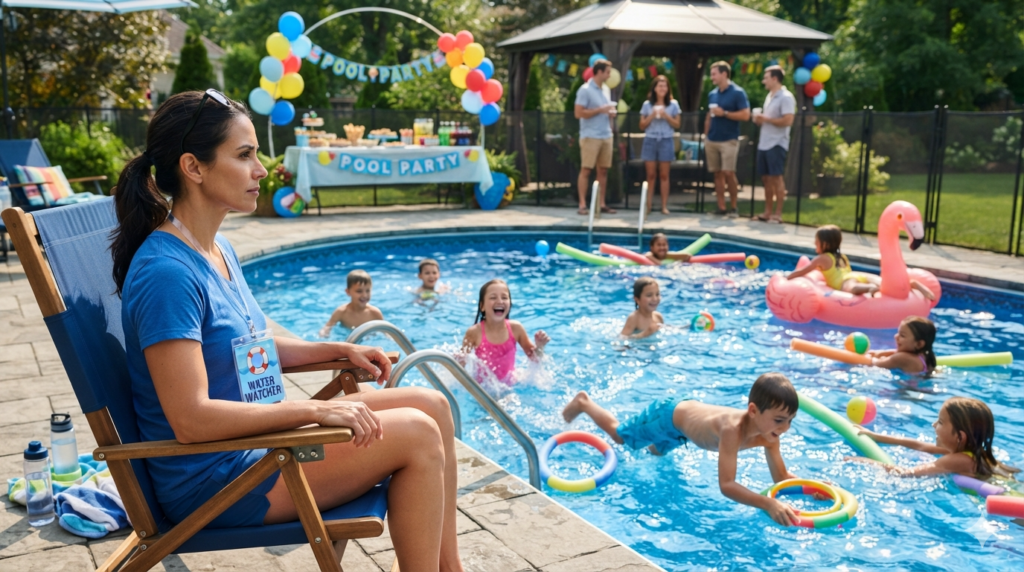
This is the single most important pool party safety decision you will make, and most hosts skip it entirely.
A water watcher is a designated adult whose only job for a set period of time is to watch the pool. Not talk to guests. Not refill drinks. Not check on the food. Watch the pool. That is the entire job description.
Why You Cannot Watch the Pool Yourself
As the host, you are the least qualified person to be the water watcher. You are being pulled in seventeen directions at once — someone needs ice, the grill needs turning, a guest just arrived, your kid is asking about the floaties. Your attention is everywhere.
That is not a failure of character. It is just the reality of hosting.
You have to assign the water watcher role to someone else. Ask them directly, in person, before the party starts. “Will you be the water watcher for the first thirty minutes?” Most people will say yes immediately. What they will not do is volunteer.
How to Structure the Rotation
How to Structure Rotations
-
30-minute shifts
Keep every watcher alert and focused.
-
Posted roster
List names and shift times at the pool gate.
-
Clear handoff
Confirm verbally before each change. No gaps.
-
4-hour party
Schedule eight consecutive shifts.
Thirty-minute rotations work well for most parties. Set a phone timer for each shift so the hand-off happens on time, not on feel. Longer than that, and attention genuinely starts to drift.
DISCLAIMER: The statement below from the National Drowning Prevention Alliance (NDPA) is an important advisory recommendation, not a legally binding regulation.
A designated Water Watcher is a responsible adult who agrees to actively and constantly supervise children when in or around water without engaging in other activities or distractions (such as social media or texting). Designated Water Watchers should rotate every 15 minutes to keep attention fresh.
Write the rotation down on paper and post it somewhere visible — a clipboard near the pool gate works perfectly. Include the water watcher’s name, the start time and their end time.
When their shift ends, they physically hand off to the next person and confirm verbally. No handoff means no shift change.
For a four-hour party with the pool open the whole time, you need eight rotation slots. That is eight adults each watching for thirty minutes. At a party of twenty or more, this is entirely achievable without anyone feeling put out.
Ground Rules for Water Watchers
Ground Rules for Water Watchers
-
Stay sober
No alcohol before or during your shift.
-
No distractions
No phones, reading, texting, or lengthy conversations.
-
Watch actively
Keep your eyes on everyone in the pool.
-
Stay present
Arrange a replacement before stepping away.
-
Emergency ready
Keep a phone accessible for emergencies only.
-
Confirm handoff
Pass the Water Watcher card and confirm the change.
The role only works if everyone takes it seriously. Be clear about the rules when you ask:
No alcohol during or before your watch. No phone. No conversations that take your eyes off the water. If you need to step away for any reason, you find your replacement first.
According to the CDC, “drowning happens in seconds and is often silent.“
Drowning does not look like drowning does in the movies. It is quiet, fast, and often happens within arm’s reach of other people. Eyes on the water, full stop.
Get Brooke’s Free Pool Party Planning Checklist
8 stages and 96 checkpoints. Print it and check each box on your way to the perfect party.
How Do You Plan for Non-Swimmers and Kids?
Pool party planning starts with knowing who is actually coming — and what they can and cannot do in the water.
When you send invitations, include a line asking guests to let you know if anyone in their group is a non-swimmer or a weak swimmer. Some people will feel awkward flagging this unprompted. Giving them the explicit opening removes the awkwardness.
Create a Mental Map of the Pool
Before guests arrive, think through where different people will likely be in the water. Strong adult swimmers will naturally migrate to the deep end. Kids and weak swimmers stay shallow. Non-swimmers stay on the steps or out of the pool entirely.
The danger zone is the transition area — the point where the pool floor drops away, and someone who thought they were fine suddenly is not. Know where that point is in your pool.
If you have young guests who are not strong swimmers, mark it clearly with a bright foam noodle stretched across the pool width.
The Kids Question
If children are coming, the supervision level goes up significantly, regardless of how good the adult-to-child ratio looks on paper.
Children under ten should have a dedicated adult with eyes on them at all times, not just a rotation watcher covering the whole pool.
That adult should be within arm’s reach of any child in the water who is not a confident swimmer. No exceptions for a quick conversation or a trip to the food table.
Children and weaker swimmers should wear a U.S. Coast Guard-approved life jacket in and around the water. Floats, noodles and water wings are toys, not safety devices.
What Pool Rules Should You Set at Your Pool Party?
Pool rules are not for children only. Adults need them, too, and adults are considerably harder to wrangle once they have had two drinks and decided running on the pool deck sounds perfectly reasonable.
Post your rules at the pool entrance. Say them out loud once to the group before the pool opens. Short, specific and non-negotiable:
No running on the deck. No diving except in designated areas. No rough play near the edges. No alcohol in the water. One person at a time on any pool toy or float.
Make them specific to your pool. If your pool has a shallow end that looks deeper than it is, say that. If your pool deck gets slippery when wet, say that too.
Shallow Versus Deep End Rules
If you have a combination of adults and children at your party, consider whether both ends of the pool need to be open simultaneously. Having children in the shallow end while adults play games in the deep end creates a chaotic middle zone that is hard to monitor.
Stagger the pool access if you need to. Kids first, then adults. Or designate clear lanes. Whatever system you use, be explicit about it.
Do You Have a Pool Fence and a Self-Latching Gate?
If small children will be near the pool, barriers matter.
The CDC reports that a four-sided isolation fence, one that separates the pool from the house and yard, reduces a child’s drowning risk by 83% compared with three-sided property-line fencing.
Make sure the gate closes and latches on its own, and keep it closed whenever the pool is not being watched.
What Poolside Safety Equipment Do You Need?
Your pool area should have three pieces of safety equipment within easy reach at all times. Not in the garage. Not inside. Poolside.
The Life Ring
A life ring — also called a rescue ring or life preserver — should be mounted on a hook near the pool, visible and unobstructed. If you do not own one, they cost under thirty dollars and are available at any pool supply or big-box store.
Do not put it in a cabinet. Do not hang a towel over it. It needs to be reachable in under five seconds.
A Reaching Pole
A reaching pole lets you extend help to someone in the water without entering the pool yourself. Entering the water to rescue someone is the last resort, not the first move — panicking swimmers can pull rescuers under.
A pole, a rope or even a pool noodle held out from the deck edge is always the better first response.
A First Aid Kit
Keep a stocked first aid kit in a consistent, known location. Before guests arrive, quickly check it: bandages, antiseptic wipes, gauze, medical tape, antihistamines and a cold pack at minimum. Tell your water watchers where it lives.
Can You Serve Alcohol at a Pool Party Safely?
This section is uncomfortable to write and more uncomfortable to ignore.
Alcohol impairs judgment, reduces reaction time and gives swimmers a false sense of confidence in the water.
These are not opinions. The CDC reports that alcohol use is involved in up to 70% of deaths associated with water recreation among adolescents and adults.
A Practical Policy That Actually Works
A blanket no-alcohol rule at a pool party for adults is impractical, and no one will follow it. What is practical is being thoughtful about the sequence.
Swimming first, drinks after. Open the pool during the first part of the party, close it or wind it down before the drinks pick up. Frame it around food — “Pool’s closing while we eat” is completely socially normal.
Broken glass on the pool deck is a safety hazard too! Stick to paper, acrylic, or better still aluminum cups!

Never use glass cups at a pool party — it is a real safety risk, and most people don’t realize until something breaks. I used to recommend clear acrylic cups, until I discovered Top Cup. Aluminum chills instantly, it doesn’t shatter, is reusable, and honestly it looks better than anything plastic I’ve ever put on a drinks table.
For anyone who has had more than two drinks, the pool is simply closed to them. As the host, you have the right and the responsibility to say it. You do not need to make it a big thing. “Hey, grab some food, and we’ll get back in later” is a complete sentence.
For Kids’ Parties
Adults who are water watching should not be drinking during or before their rotation. This is non-negotiable. Put it in the rotation briefing. Offer them a great non-alcoholic drink to make it feel less pointed.
How Do You Check Pool Drain Safety?
This one is less discussed and important enough to mention directly.
Pool drains create suction that can trap hair, limbs and swimsuit fabric. Public pools in the US are required to have drain covers that meet federal anti-entrapment standards, but a home pool is not guaranteed to, and covers can age, crack or go missing.
Before any party where children are swimming, visually inspect your drain cover. It should be flat, uncracked and firmly in place. If it is damaged or missing, keep the pool closed for that party and get it replaced. It is a thirty-dollar repair, and it matters.
Keep long hair tied up for young swimmers. Avoid loose, baggy swimwear that can catch on drains.
How Do You Protect Guests from Sun and Heat?
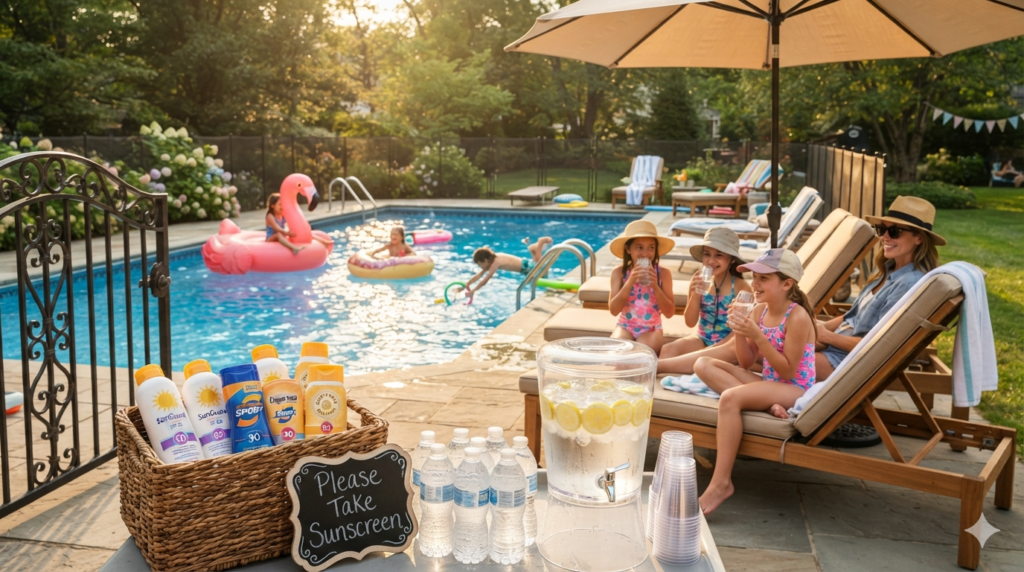
Sunburn is the most common pool party injury and the most consistently ignored. Have sunscreen available at the pool — not just packed in a bag somewhere.
A basket near the pool gate with several bottles of SPF 30 or higher, broad-spectrum, water-resistant sunscreen invites people to use it.
Reapply at least every two hours, and again after swimming, sweating, or toweling off. Most guests will skip it unless the sunscreen is right in front of them.
“I’m always surprised at how many guests arrive at pool parties without sunscreen. That’s why I set out a few tubes of ANUA Zero‑Cast Moisturizing Finish Sunscreen for everyone to use. It’s water‑resistant, SPF 50, lightweight, and works for all skin types — my go‑to for keeping guests protected in the sun.”
The Heat and Young Children Question
Children overheat faster than adults and are less likely to tell when they feel unwell. If it is extremely hot and humid, set a schedule for children to take breaks in the shade and drink water.
Hydration matters more than most hosts realise — kids who are active in the pool are sweating even though they do not feel it.
For children under two, sun exposure should be minimal. Shade, sunscreen on exposed skin and cool fluids.
Weather Monitoring
A thunderstorm with lightning means everyone should get out of the pool immediately. Not in a minute. Immediately. Lightning and water are not a risk worth managing — it is a risk worth eliminating.
Check the forecast the morning of your party. Have a loose contingency plan — a covered patio, an indoor space, a two-hour delay — so if the weather turns, you are not making decisions on the fly with twenty guests staring at you.
The Thirty-Minute Rule
After any lightning strike or thunder, wait a full thirty minutes before allowing anyone back in the water. Not fifteen minutes. Not until it looks clear. Thirty minutes from the last thunder or visible lightning.
If your party is happening at the height of summer storm season, an afternoon electrical storm is genuinely common in most of the South. Build a flexible window into your schedule rather than a rigid pool-open time.
The Pre-Party Safety Walk-Through
This is the habit that separates experienced pool hosts from hosts who are improvising.
The morning of your party, before guests arrive, walk the pool area with a deliberate eye for anything that does not belong there. Here is exactly what you are looking for.
The Walk-Through Checklist
- Check the pool gate — it should latch and lock properly.
- Check the drain cover — flat, uncracked, firmly in place.
- Check your life ring — mounted, unobstructed and reachable.
- Check your first aid kit — stocked and in its designated spot.
- Clear the pool deck of any tripping hazards — bags, shoes, toys, and electrical cords.
- Check your pool toys and floats — deflated or cracked equipment goes in the trash, not the pool.
- Confirm your water watcher rotation is written down, and the first watcher knows they are on.
This walk-through takes less than ten minutes. Do it every single time.
A Note on Emergency Preparedness
Know where the nearest AED is located. Know the exact address of your home so you can give it quickly to emergency services. Have your phone accessible during the party — not inside, not in a bag, actually accessible.
If you have children swimming who are not yours, have the parents’ phone numbers saved before the party begins. You do not want to be searching through invitation texts while something is unfolding.
Take a CPR refresher class. The American Red Cross and many local YMCAs offer CPR and first aid classes, and most take only a few hours.
If you host pool parties regularly, this is worth doing once every few years.
Reference Sources
Here are the exact URLs for each of the official resources I checked for writing this article. Nonetheless, this article is general information, not medical advice.
- CDC (Drowning Facts): CDC Drowning Facts Data & Research
- American Red Cross (Water Safety): American Red Cross Drowning Prevention & Facts
- American Academy of Pediatrics (HealthyChildren.org): HealthyChildren.org Infant Drowning Prevention & Water Safety
- National Weather Service (Lightning Safety): National Weather Service Lightning Safety Program
- U.S. Consumer Product Safety Commission (Pool Safely): CPSC Pool Safely Campaign Website
This is for informational purposes only. For medical advice or diagnosis, consult a professional.
Safety Is the Foundation
I said at the beginning that I spent forty-five minutes on the charcuterie board the first time I hosted a large pool party. I have thought about that a lot since.
The food was lovely. I cannot tell you what was on the board. What I remember is that no one watched the pool properly that afternoon, and we got lucky.
The most beautiful pool party is the most organised one, and the most organised one has a water watcher rotation on a clipboard, a life ring on the fence and a host who walked the deck before anyone arrived.
Everything else — the food, the floats, the decorations, the playlist — is built on top of that foundation. Get the foundation right first.
For the full planning walkthrough: How to Plan a Pool Party: The Ultimate Step-by-Step Guide →
For the complete prep timeline: The Ultimate Pool Party Checklist →
Pool Party Safety: FAQs
What is a Water Watcher?
A designated adult whose only job is to watch the persons in the pool. No chatting, drinks, or phone use. At shift end, they hand off to the next person and confirm.
How long should a Water Watcher shift be?
Not longer than 30 minutes. Longer invites distraction. Reduce it to 15-20 minutes if there is overcrowding or a higher ratio of weak swimmers and children.
What poolside safety equipment is a must-have?
Keep a life ring, reaching pole, and stocked first aid kit by the pool — not stored away. You should be able to reach the life ring in under five seconds.
Is alcohol safe at a pool party?
Alcohol impairs judgment and balance; the CDC links it to up to 70% of water‑recreation deaths. Open the pool before drinks, never let a Water Watcher drink, and close the pool to anyone with more than two drinks.
When should guests exit for lightning?
Immediately at the first sign of thunder or lightning. Wait 30 minutes after the last strike before re‑entering the pool.