Easy to Host Kids Pool Party Ideas for Every Age & Budget
A kids’ pool party is one of the easiest parties to overcomplicate, but also one of the most forgiving parties to get right.
Children do not arrive with a critical eye for the balloon arrangement. They arrive ready to get wet, eat something they like, and have more fun than they had at school last week. The pool is the party. Everything else is the supporting cast.
That said, the difference between a kids’ pool party that parents talk about afterward and one that is merely fine is not the amount spent. It is the quality of the specific decisions made for the specific age group in attendance.
A party planned for a five-year-old should look nothing like a party planned for a ten-year-old. The food, the activities, the supervision structure, the decoration register — every element should be calibrated to the actual children attending rather than to a generic “kids’ party” template.
This guide covers every age group from toddlers through to the edge of the teen years, and every budget from a genuinely minimal spend to a more generous investment. Whether the party is for six children or thirty, whether the budget is two hundred dollars or two thousand, there is a version of the kids’ pool party that works beautifully.
This guide covers everything you need:
- age-specific planning guidance from toddlers to pre-teens,
- theme ideas that work at every age and budget point,
- food and drink ideas that children actually eat rather than inspect and put back,
- activities that work for each age group, rather than a generic games list,
- and the safety framework that makes the whole thing work responsibly for every age
Here is how to get it right.
📣 Splash Bash Pass helps you plan the perfect kids’ pool party with an age-specific checklist, activity guide and water watcher rotation. Try it free →
Age-Specific Planning: The Foundation of Everything
The single most common kids’ pool party planning mistake is treating a six-year-old’s party and a ten-year-old’s party as the same event with different cake toppers.
They are not. The activities that thrill a five-year-old might actually bore an eleven-year-old. The supervision structure appropriate for a toddler pool party is unnecessary at a pool party for confident twelve-year-old swimmers. The decoration register that delights a seven-year-old embarrasses a pre-teen.
Plan for the actual age of the children attending. Not the age you remember enjoying parties. Not the age that suits the decorations you already like.
Toddlers and Under-Fives
A pool party for very young children is a different event from any other pool party. The pool is a splash zone rather than a swimming pool.
Every child in the water needs one-on-one adult supervision, not a water watcher rotation — every child needs a dedicated adult in or directly beside the water at all times.
What works: A shallow paddling pool or the top step of a full pool. A separate splash pad on the lawn. Water play tables. Short, highly structured activity windows with immediate adult engagement. The party runs for no more than ninety minutes.
What does not work: Deep pool access for non-swimmers. Unsupervised pool time. Activities that require sustained attention. A party that runs longer than the typical toddler’s attention and energy window.
Themes that land: Animals — dinosaurs, unicorns, sea creatures — bright primary colors, a favorite children’s television character, if licensing permits use of the imagery.
Keep the decoration register playful and bold. Toddlers respond to color and recognizable images rather than aesthetic coherence.
Food: Small portions, familiar foods, easy to eat without cutlery. Fruit cut into small pieces. Mini sandwiches with crusts removed. Cheese cubes. Crackers. A small birthday cake if it is a birthday party. Avoid foods that are choking hazards for the youngest children.
Ages Five to Eight
This is the sweet spot for a really great kids’ pool party. Children in this range are old enough to participate in structured activities, young enough to be enthusiastic about them without self-consciousness, and excited enough about a party to carry the energy through the full event.
What works: A clear theme with strong visual language. Structured activities that feel like games rather than facilitated programmes.
A treasure hunt. A defined activity sequence — swimming, games, food, cake — rather than an open format. The party runs for two to two and a half hours.
What does not work: Activities with complex rules. A completely unstructured format — this age group benefits from knowing what comes next. Decoration that is too sophisticated for the age, which children register as not really being for them.
Themes that land: Mermaid, pirate, dinosaur, unicorn, superhero, under the sea, tropical, beach, safari. Strong visual language, commercially available decorations, and a clear connection to what children this age are currently excited about.
Food: Child-sized portions of universally liked foods. Mini hot dogs or sliders. Pizza portions. Watermelon wedges. Chips. Fruit. Cupcakes rather than a large cake that requires slicing — less logistics, same celebration.
Ages Eight to Twelve
The pre-teen pool party requires more sophistication in the activities and more involvement of the birthday person in the planning decisions.
Children in this range notice when a party is planned for a younger version of them. They also notice when a party actually reflects their current interests and tastes.
What works: Competitive activities with real stakes and real prizes. A clear theme that the birthday person chose rather than the one that the parent chose. A playlist the birthday person curated.
More independence in the pool time. Less adult facilitation of activities so that the group can organise themselves. The party runs for two and a half to three hours.
What does not work: Activities designed for younger children. Decoration that reads as babyish. A parent-planned theme that the birthday person had no input into. An overly structured programme that leaves no room for the group to simply play in the pool.
Themes that land: Glow party, sports theme, favorite movie or book series, tropical, beach, specific hobby or interest. The theme should come directly from the birthday person.
At this age, a theme that reflects who they actually are matters far more than a commercially popular one.
Food: More substantial portions, more variety, slightly more sophisticated flavors than the younger age group. Taco bar. Pizza. Loaded nachos. Sliders. Fruit. The candy and dessert station matters enormously to this age group. Give it real attention.
Theme Ideas by Budget
Budget Tier One: Under $150
A beautiful kids’ pool party under $150 is entirely achievable when the decoration investment is focused rather than scattered.
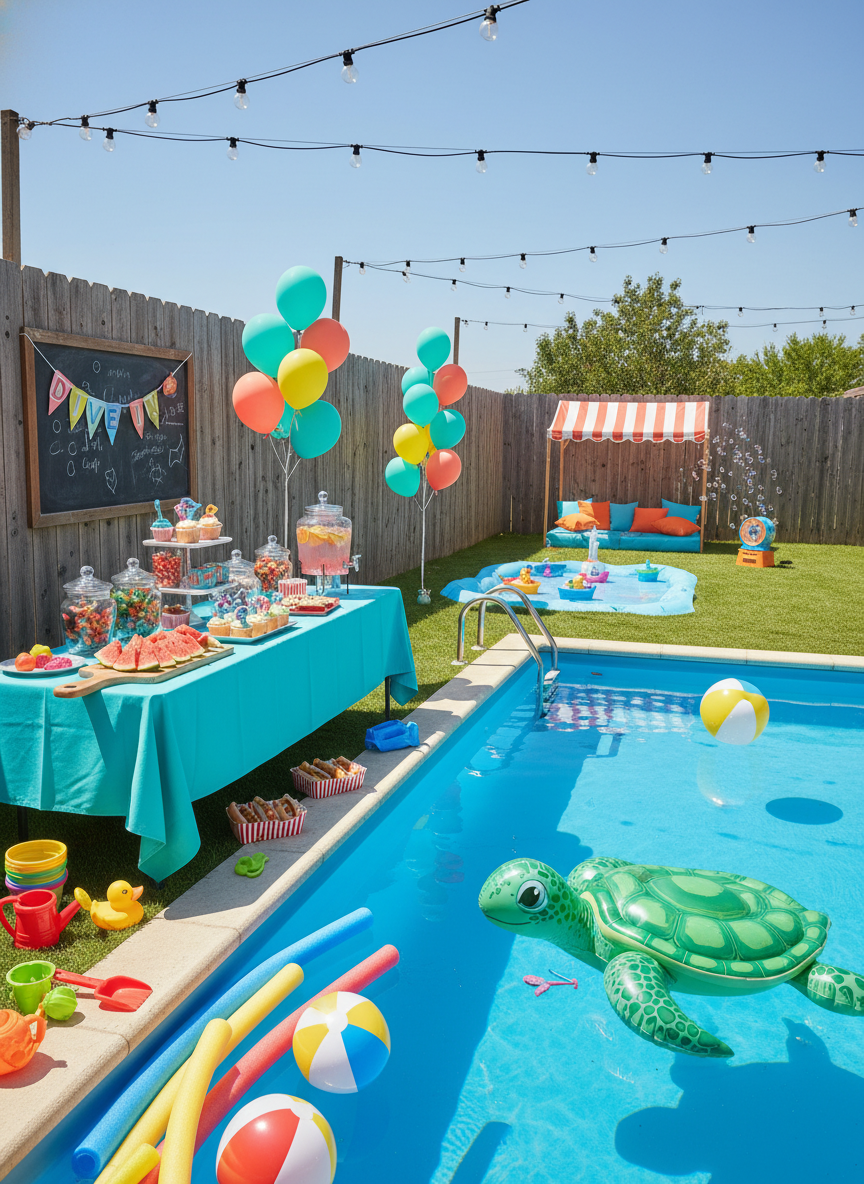
The focused one-theme approach: Pick a single theme. Buy one themed tablecloth, one balloon garland kit in the theme colors, one set of themed plates and cups, and one themed banner.
Everything else — food, pool toys, activities — runs in the theme colors without requiring licensed merchandise.
A unicorn party with a purple and pink tablecloth, a balloon garland from a kit in lavender, white, and gold, a “Happy Birthday” banner, and a batch of rainbow cupcakes made at home costs under $80 in decoration materials and photographs as a fully realized themed party.
Pool toys as decorations: Brightly colored pool noodles in a bucket at the pool edge. Inflatable beach balls floating in the pool. A single large character float as the statement piece.
These serve double duty — they are activities and decorations simultaneously, which is one of the most efficient uses of a limited party budget.
DIY food: A store-bought cake with a themed topper added at home. Homemade cupcakes with colored frosting in the palette colors. A fruit platter arranged in a rainbow or star shape.
The food at a kids’ pool party costs minimally to produce, and the children care about taste and color, not the complexity of preparation.
Activities that cost nothing: A treasure hunt with clues written at home. A cannonball contest. A pool noodle jousting game. A watermelon-eating contest. The best kids’ pool party activities are almost always free.
Budget Tier Two: $150 to $400
In this range, the party can add one or two investment elements that elevate the setup significantly without resorting to comprehensive commercial decoration.
A balloon garland professionally assembled: A local balloon artist assembling a three to four-foot garland in the theme colors for the food table backdrop runs between $80 and $150, depending on location and complexity.
This single element transforms the food table from a home party setup into something that looks styled.
A custom cake: A custom themed birthday cake from a local baker runs between $60 and $150 for a two-tier design. It replaces the homemade option and creates the memorable hero moment of the party in a way that most other decoration investments do not.
Hired water play equipment: A portable water slide or a large splash pad hired for the day adds a significant activity element that no decoration can replicate.
Children will use it for the entire duration of the party, and it generates the most shared photographs of the afternoon.
Character or entertainer for one activity: A face painter, a bubble artist, a magician for one thirty-minute slot during the party.
The entertainer handles one activity segment, which takes pressure off the host to facilitate and gives the party a professional-feeling moment that children remember as the event of the afternoon.
Budget Tier Three: $400 and Above
With a more generous budget, the kids’ pool party can include elements that create outstanding event production quality rather than just a well-decorated afternoon.
A hired water inflatable: A full water slide, inflatable obstacle course, or a large bouncy castle with water features, hired for the day, is the activity investment that generates the most excitement and the most extended engagement from children of every age.
A food station with a caterer: A snow cone machine operated for the party duration. A popcorn cart. A taco station staffed by a caterer for one hour. These add a carnival or event atmosphere that elevates the party beyond the standard home birthday format.
A photo booth service: A professional photo booth with a branded template, a printer, and a photo strip guests take home. Children use it relentlessly, and the printed strip becomes an immediate party favor.
Full decoration installation: A professional balloon artist installing a full arch, a backdrop, column clusters, and pool-edge decorations. Styled table with hired linens, plates, and a styled dessert table. This level of production takes the visual from a home party to an event-caliber setup.
Pool Party Themes for Kids: The Best Options
Mermaid Pool Party
Consistently the most requested theme for girls aged four to ten. The pool is the natural setting. Mermaid tail swimsuits are widely available. The color palette — teal, purple, seafoam, and gold — is beautiful in photographs.
The mermaid pool party guide covers every element in detail — the mermaid pool party guide is the most complete resource for this theme.
Pirate Pool Party
The best adventure theme for mixed-gender groups aged five to ten. The treasure hunt is the activity engine. The decorations are easy to source. Every child arrives wanting to participate. The pirate pool party guide covers the treasure hunt setup in full.
Under the Sea
A slightly more expansive version of the mermaid theme — broader in creature range, more gender-neutral, and with more visual variety in the decoration palette. The under the sea pool party guide covers every element.
Tropical and Beach
Low-commitment themes that work across every age group and require the least explanation. Children arrive in swimwear, the pool is the beach, and the decorations are bright and warm. The beach theme pool party guide has the full setup framework.
Glow Party
For ages eight and above. The UV lights, neon paint, and glow accessories make the pool feel like an entirely different environment. Works especially well for a late-afternoon to early-evening party that transitions after dark.
The glow pool party guide covers every element, including the age-appropriate approach.
Dinosaur
One of the most consistently popular themes for children aged three to eight. Strong visual language, commercially available decorations, and enthusiastic participation from the guest group. A volcano cake. Dinosaur egg hunt. Face painting as dinosaurs. It runs itself.
Unicorn and Rainbow
The counterpart to dinosaur for the same age range. Pastel colors, rainbow elements, horn headbands, and a glitter station. Works especially well for a combined girls’ birthday party format.
Sports Theme
For the child who is not interested in character or creature themes. A specific sport — soccer, swimming, gymnastics, basketball — as the theme.
Team colors as the palette. Sport-specific activities and equipment as the party activities. Medal ceremony at the end of the party, with every child receiving a medal.
Here is how to get it right.
📣 Splash Bash Pass helps you plan the perfect kids’ pool party with an age-specific checklist, activity guide and water watcher rotation. The app has several in-built kid-friendly pool party themes. Try it free →
Food for a Kids’ Pool Party
The Golden Rules
Children eat more when they are active and outside. Plan for more than you think you need.
Children at a pool party eat in short bursts between swimming. The food does not need to be elaborate. It needs to be available, easy to eat with wet hands, and yummy.
Avoid foods that are difficult to eat without cutlery at a pool party. Saucy pasta, large salads, anything that requires sustained concentration to eat without mess. A child who is half-distracted by the pool will not manage a complex plate.
Keep sugar timing in mind. Sugar before pool time creates a specific combination of energy and impulsivity that complicates water safety management. Sugar after pool time, during or after the cake moment, is the right sequence.
The Food That Works
Watermelon wedges — the most universally consumed food at any children’s pool party, regardless of age or preferences. Buy one large watermelon, cut into wedges, and arrange on a board. Done.
Mini hot dogs or sliders — universally liked, easy to eat, and hold well outdoors. Serve with ketchup and mustard in small squeeze bottles.
Pizza — either from a local delivery timed for the main food moment or homemade flatbread pizzas with child-assembled toppings as an activity. Universally liked and the easiest group food to manage at a party.
Corn on the cob — classic summer food that children eat enthusiastically. Boil a batch, keep warm in foil, and serve with butter.
Fresh fruit platter — grapes, strawberries, watermelon, pineapple chunks, and orange segments arranged on a board or in a large bowl. The one element that parents universally appreciate and children actually consume.
Chips and dips — the background snack that runs through the full party duration.
Goldfish crackers, pretzels, and popcorn in individual bags or cups — pool-friendly snacks that children carry back to the water without disrupting the food table.
The Cake Moment
At a kids’ pool party, the cake moment is the centerpiece of the party — more so than at any other type of pool party.
Plan the timing deliberately. Bring children in from the pool with ten minutes’ warning. Dry them off. Gather around the table. Candles lit. Song sung. The birthday person blows out the candles.
This sequence takes about eight minutes, and it is the eight minutes that every parent in attendance is filming.
Cupcakes with a themed topper rather than a full sliced cake are the practical choice for a large group. No cutting, no serving logistics, no waiting for a slice. Each child gets their own.
Faster, simpler, and the photography is often better — a table of thirty children each holding their own cupcake is a better photograph than a cake being sliced by an adult.
If a full cake is the preference, use a cake cutting board and have the slices pre-plated rather than passing each one individually. Time saved is energy saved at the point in the party when the host is most tired.
The Sweet Station
For ages five and above, a sweet station — jars and bowls of the birthday person’s favorite candies and sweets arranged in the palette colors — is the most visited section of the food table by children and the most photographed section by parents.
It costs minimally to assemble, requires no preparation, and children treat it as a destination. Position it away from the main food table so it does not create congestion at the main serving area.
Drinks
Juice boxes — the most practical drinks format at a kids’ pool party. Individual, no spillage risk, no glass near the pool, children manage them independently.
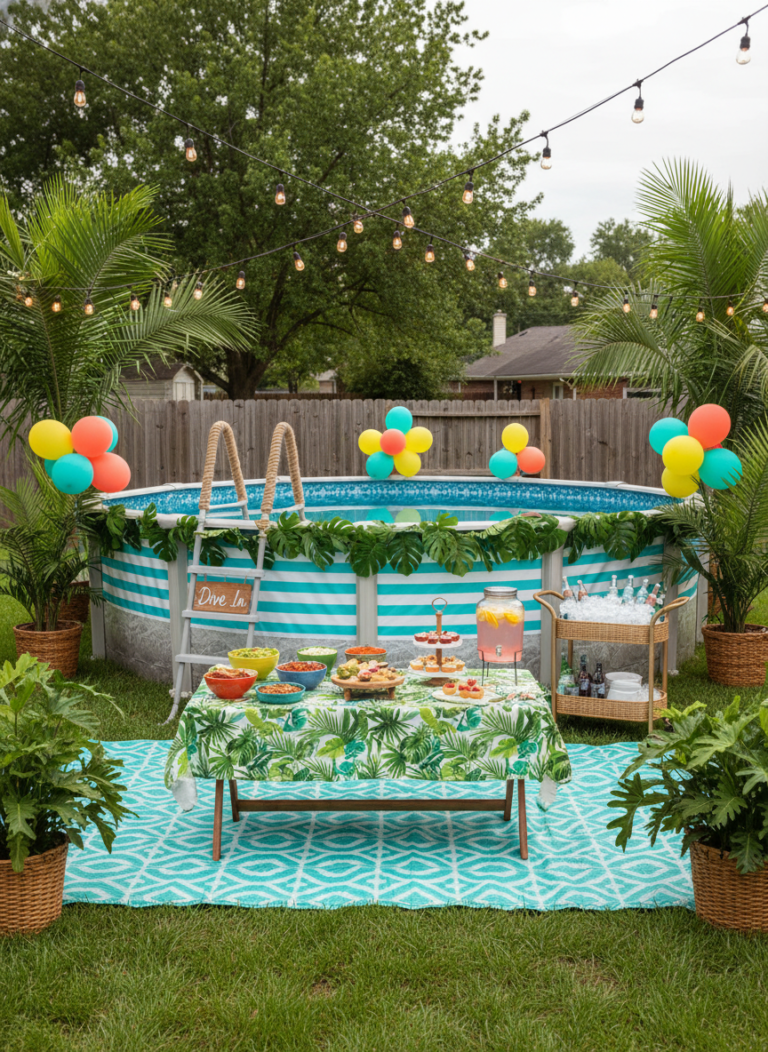
Lemonade from a large dispenser — in the theme color, if possible. Pink lemonade, blue lemonade with food coloring, or standard lemonade in a clear dispenser with fruit slices. Children love a themed drink and the visual of the drink dispenser itself.
Water, always — a dispenser of plain cold water available throughout. Active children need it regardless of how enthusiastically they are drinking juice.
Avoid carbonated drinks for very young children. Avoid any drink in a glass container near the pool for any age group.
Activities by Age Group
Ages Two to Five
Splash pad — a ground-level splash pad on the lawn is the safest water activity for the youngest children. No depth, no drowning risk, infinite entertainment.
Water table — a low table with water, small toys, cups, and funnels. Children this age will occupy themselves for extended periods at a water table with minimal facilitation.
Bubble station — a bubble machine running continuously. Children this age do not tire of bubbles.
Duck fishing — small plastic ducks floating in a paddling pool, children fish them out with small nets. Mark the underside of some ducks with colors or numbers as prizes.
Sandpit play — a sandbox on the lawn beside the water area. Children who want a break from water can transition naturally.
Ages Five to Eight
Treasure hunt — as described in the pirate pool party guide, the treasure hunt is the single most engaging structured activity for this age group, regardless of theme. Adapt the narrative to the theme — a mermaid treasure hunt, a dinosaur egg hunt, a rainbow treasure hunt.
Cannonball contest — announced, judged, with prizes. Children take this very seriously.
Water balloon toss — pairs of children tossing a water balloon back and forth, taking one step back after each successful catch. The last pair with an intact balloon wins. Simple, competitive, enormous fun.
Freeze dance in the splash zone — music plays, children dance in the splash pad. When the music stops, everyone freezes. Last child moving is out. Runs for fifteen minutes and produces total chaos in the best possible way.
Pool noodle ring toss — pool noodles cut into rings, tossed over a vertical noodle or a pool toy. Simple to set up, competitive without being exclusionary.
Ages Eight to Twelve
Pool volleyball — an inflatable net across the pool or a ball game with agreed-upon rules played in the water. Older children organise themselves once the equipment is provided.
Diving challenges — a diving ring set dropped to the pool floor, children competing for the most retrieved in one dive. Or a distance or accuracy challenge off the pool edge.
Relay races — teams racing a pool noodle, a float or a specific swimming stroke across the pool and back. Competitive, fast, and loud in all the right ways.
Waterproof trivia or card games — for the moments between swimming when children want activity without re-entering the water.
DIY photo booth — a backdrop with a props basket. Older children in this range will use it enthusiastically and independently, sharing photographs within the group before the party ends.
Party Favors
Party favors at a kids’ pool party are most effective when they extend the theme and the activity of the afternoon.
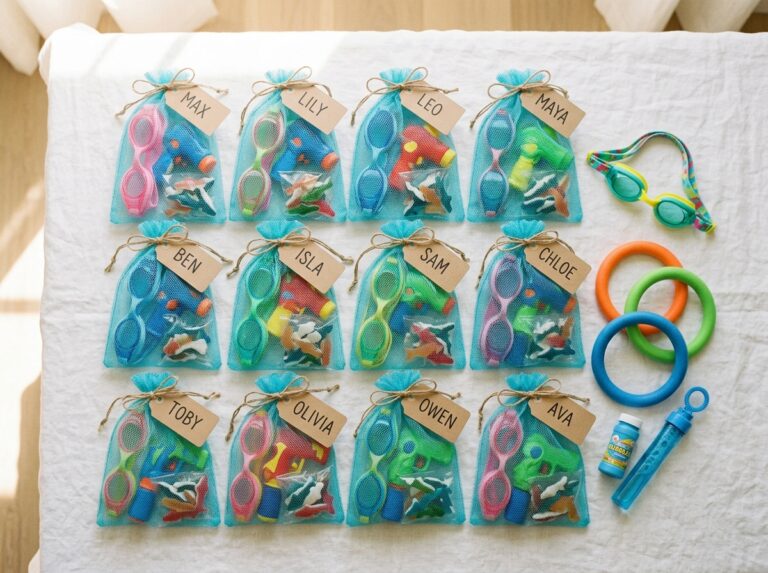
For younger children: A small themed toy — a sea creature, a dinosaur figurine, a mermaid doll — in a small bag with a few sweets and a thank-you card.
For ages five to eight: A themed activity item — a small set of watercolors, a sand art kit, a themed sticker book — alongside a sweet selection. Something that extends the party experience beyond the afternoon.
For ages eight to twelve: A slightly more considered favor — a personalized item with the birthday person’s name and the party date, a quality sweet selection, a game or activity that the group can continue using.
Avoid toys that feel babyish for this age group. When in doubt, a quality sweet bag is always well received.
The favor bag itself: A themed bag in the palette color, a box tied with ribbon, or a simple kraft paper bag with a sticker seal in the theme color. The container does aesthetic work without requiring expensive contents.
Managing the Party on the Day
The Activity Sequence
A clear activity sequence prevents the energy vacuum that produces bored children and overwhelmed hosts.
A suggested structure for a two-and-a-half-hour party: free pool play for the first thirty to forty minutes while guests arrive and settle, structured activity for twenty to thirty minutes, back to pool for twenty minutes, food time for thirty minutes, cake moment, free play and gradual departure.
Brief one other adult on this sequence before the party starts, so the transition moments are managed by two people rather than one.
The Weather Plan
Every outdoor kids’ party needs a backup plan for rain or extreme heat. Know what the backup is before the day — a covered area, a garage, an indoor contingency — and communicate it to parents if the weather is uncertain in the week before the party.
For extreme heat, position a shaded area with misting fans beside the pool. Have cold water available at all times. Limit time in direct sun for younger children and apply sunscreen before the party begins and again at the midpoint.
📣 Splash Bash Pass helps you plan the perfect kids’ pool party with an age-specific checklist, activity guide and water watcher rotation. It even has a Weather Tab within the App. Try it free →
The End of Party Logistics
Brief parents at drop-off on the party end time and the collection procedure. An unorganised end of party, where children are collected at different times, and the food table is still fully stocked, and guests are still arriving, runs significantly longer than planned and is exhausting for the host.
Organize party favors in advance so they are ready at the exit point. Have dry towels available for collection. Give children a five-minute warning before the party officially ends so the transition to home is not abrupt.
Safety: The Foundation of Every Kids’ Pool Party
Water safety at a kids’ pool party is the one element that has no budget tier and no optional status. It applies at every age, every guest count, and every pool type.
The Water Watcher Framework
Every child in or near the water needs an attentive, designated water watcher. At a party, the host cannot simultaneously manage food, guests, activities, and water safety.
The water watcher role must be assigned to someone whose only job during their rotation is watching the water.
The number of water watchers required scales with the guest count and the age of the children:
For toddlers and under-fives: one adult per child in the water, always. This is not a water watcher rotation — it is one-on-one supervision for every child in the water at every moment.
For ages five to eight: one dedicated water watcher per six to eight children in the water simultaneously.
For ages eight to twelve: one dedicated water watcher per ten to twelve children, with a second available.
Rotate every thirty to forty-five minutes. Brief every watcher at the start of the party. The watcher has no other responsibilities during their rotation.
Life Vests
Any child who is not a confident swimmer should be in a properly fitted life vest in the water. This is non-negotiable regardless of how shallow the pool is, how short the swimming session will be, or how close an adult is standing.
Provide a selection of life vests at the entry point of the pool for any child who needs one. Do not rely on parents to bring their own — some will forget, some will not own one, and some will underestimate their child’s swimming confidence.
Pool Rules at the Start
Gather all children at the pool edge before the first swim session begins. State the rules clearly, simply, and once: no running on the pool deck, no pushing, no diving in the shallow end, everyone listens to the adult who says stop.
For a children’s party, the birthday person reinforcing the rules alongside the adult — “these are the rules at my pool party” — has more compliance impact than the adult stating them alone.
Know Every Child’s Swimming Level
At drop-off, ask every parent directly: Is your child a confident swimmer, a developing swimmer, or a non-swimmer? This information determines life vest requirements, pool zone access, and the water watcher’s attention allocation for that specific child.
Do not rely on children to self-report accurately. A seven-year-old who says they can swim may mean they can splash across the shallow end with their feet touching. Ask the parent.
For the complete water safety framework: Pool Party Safety Tips Every Host Needs to Know →
The Party They Talk About on Monday
The kids’ pool party that earns a reputation does not require the biggest budget or the most elaborate setup.
It requires decisions calibrated to the actual children attending. Food they will eat. Activities they will throw themselves into. A theme that reflects who the birthday person actually is. A safety framework that means every parent drives home without anxiety.
The treasure hunt that led to the pool edge. The cannonball contest that produced the afternoon’s best photograph. The cupcake with the themed topper that the birthday person carried into the car for the journey home.
These are not production achievements. They are the natural result of planning with the children in mind rather than planning for the idea of a perfect party.
For more kids’ pool party inspiration by theme, the pool party themes guide covers twenty directions across every age group. For the toddler-specific safety framework, the pool party safety guide covers every age group in full detail.
🎈 Let Marina Plan the Kids’ Pool Party
Age-specific activity guide, food plan, theme direction, guest list, and a water watcher rotation scaled to the number of children attending — Splash Bash Pass coordinates every element so the host can actually enjoy the afternoon. Use the app to find party suppliers near you.
Meet Marina, your AI pool party specialist inside Splash Bash Pass.
🗓️ Guest list and RSVPs tracked in real time
💰 Budget tracking by category, planned vs actual
📣 Complete Glow theme plan with lighting setup, decor, and music direction
📍 Top local party suppliers and UV equipment rental found near you via Google Maps
🛡️ Water Watcher assignments and safety checklists, including after-dark pool safety
☀️ Live weather monitoring with automatic backup plans
🎨 40+ curated themes including Glow, Night Pool Party, Neon, and more
🪄 Paste your messy notes, and Marina organizes them instantly
Onboarding is completely free.