Pool Party Games for All Ages that Everyone Loves to Play
The hardest thing about pool party games isn’t finding ideas. It’s finding games that actually work when your guest list is a mix of six-year-olds, teenagers, adults who want to swim, adults who don’t, and at least one grandparent who came for the food.
A pool party that serves everyone — where the kids are genuinely occupied, the teenagers aren’t staring at their phones, and the adults are having fun rather than just supervising — requires a little more thought than a list of games.
This guide organizes everything by age group and setting, then gives you mixed-group strategies that make the whole afternoon work as one coherent party rather than several separate ones happening at the same time.
Before You Plan the Games: The Two Principles That Matter
Always have the pool itself as the primary activity
The pool is already the best game at your party. It requires no equipment, no rules, no teams, and no explanation. Every game must supplement the pool, not replace it.
This means you need far fewer organized games than most hosts think — two or three well-chosen options, set up and available, is genuinely enough.
Games work best when they’re available, not mandatory
The worst pool party game is one that requires the entire group to stop what they’re doing and participate.
The best ones are always available in the background — the cornhole set up on the lawn, the diving rings already in the pool — and people drift in and out naturally.
Your job is to set things up, not to run a programme.
Games for Young Kids (Ages 3–8)
Young children at a pool party need games that are safe in shallow water or near the pool edge, easy to understand without lengthy explanation, and possible to abandon mid-game without anyone being upset.
Diving rings and pool toys
Drop a set of brightly coloured diving rings to the bottom of the shallow end and let children collect them. This is the highest-value pool party purchase for any party with young children — a set costs $8–$12 and will occupy a group of kids for the entire afternoon.
For slightly older children in the 6–8 range, turn it into a competition: whoever collects the most rings in 30 seconds wins the round (and gets a prize!). Reset and repeat. It self-sustains for hours.
Duck duck splash
A pool-appropriate version of duck, duck, goose. Children sit at the edge of the pool with their feet in the water. The child who is “it” walks around the outside, tapping each child’s head and saying “duck.”
When they say “splash,” that child jumps into the pool and tries to tag the “it” player before they can take the empty spot.
Works in the shallow end with adult supervision. Requires no equipment. Generates immediate excitement from the first round.
Freeze tag in the pool
One child is “it.” When tagged, children must freeze in place in the water — arms out, unable to move — until another unfrozen child swims through their legs to unfreeze them. The “it” player wins by freezing everyone simultaneously.
This game has a surprising longevity for its simplicity. Children ask to play it multiple times. It requires nothing beyond willing participants and a clear, shallow area.
Water balloon toss
Two children stand facing each other a short distance apart and toss a water balloon back and forth, taking one step back after each successful catch. The pair that catches the balloon from the furthest distance without breaking it wins.
It is loud, messy, and universally beloved. Set up a water balloon station — a bucket of pre-filled balloons — near the pool and let children self-organize. The burst balloons clean up easily on grass or a hard surface.
Buy a bunch-at-once filling tool if you’re making more than twenty balloons. Filling them individually is the work of a long afternoon.
Musical floats
The pool version of musical chairs. Place one fewer inflatable float in the pool than the number of children playing. When the music stops, every child must be on a float. Whoever doesn’t have a float is out. Remove one float each round.
Works in the shallow end with children who can swim or with adult-supervised non-swimmers near the wall. Music from a waterproof speaker adds to the chaos in the best possible way.
Games for Tweens and Teenagers (Ages 9–16)
This is the group that breaks most pool party game plans, because they’re simultaneously too old for children’s games and too self-conscious to throw themselves into adult-style games without a little momentum first.
The key is games that are competitive enough to be genuinely engaging and active enough that the competitive element feels earned.
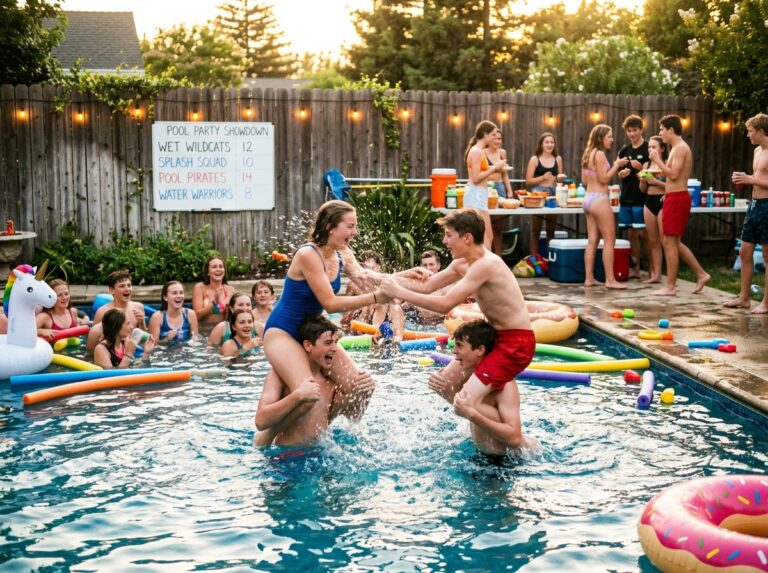
Noodle jousting tournament
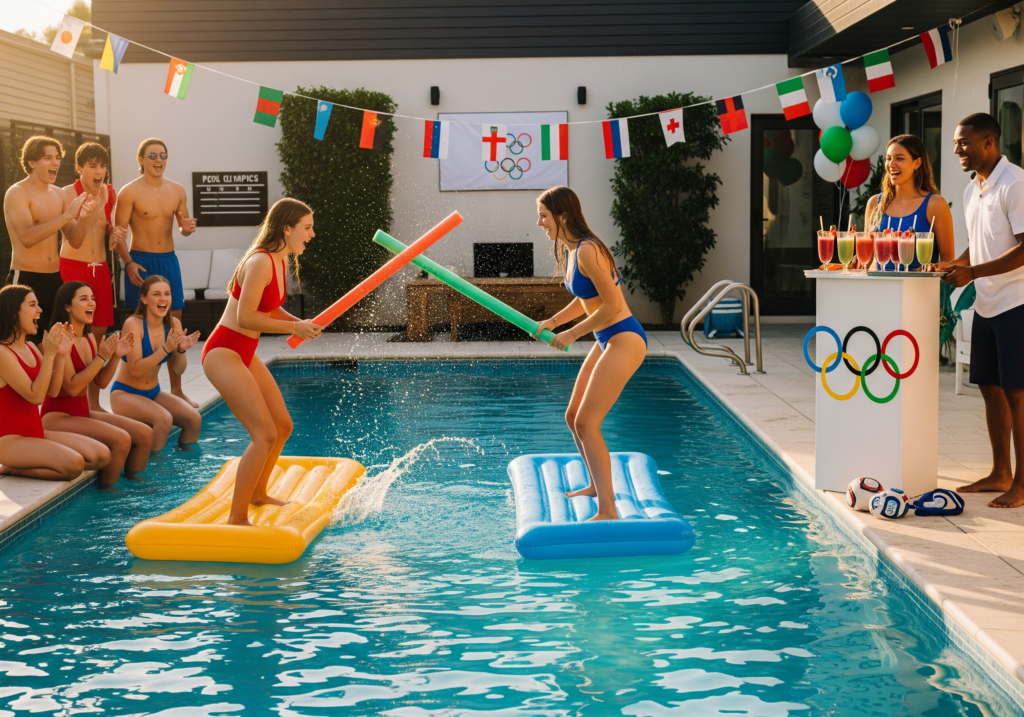
Two players sit on pool floats facing each other, each holding a pool noodle. The goal is to knock the other player off their float using only the noodle. Bracket-style tournament with a prize for the winner.
Teenagers commit to this game immediately once the first round starts. The combination of competition, physical activity, and the spectacle of watching someone fall off a float hits exactly the right notes for this age group.
Requires two pool noodles ($2–$3 each) and two pool floats. Runs itself once you set up the bracket.
Team relay races
Two teams race across the pool using specific rules — no arms, holding a pool noodle between the knees, pushing a ball with your nose. Each round has a different rule. The team with the most round wins takes the tournament.
Mix teenagers and younger adults in the teams for a format that bridges the gap between age groups naturally.
Sharks and minnows
One person is the shark in the middle of the pool. Everyone else is a minnow at one end. On “go,” the minnows try to swim to the other end without being tagged. Tagged players become additional sharks. Last minnow standing wins.
Teenagers rediscover their enthusiasm for this game almost every time it’s introduced, even when they initially seem too cool for it. The competitive element — being the last minnow — provides enough of a hook.
Volleyball and keep away
Pool volleyball with a net ($25–$50) works for teenagers as a continuous background activity. Keep away — three or more players try to prevent one player in the middle from intercepting the ball — works with any number of players and no equipment beyond a ball.
Both games can run simultaneously for different energy levels: volleyball for the more competitive players, and keep away for those who want to stay active without the structure of a proper game.
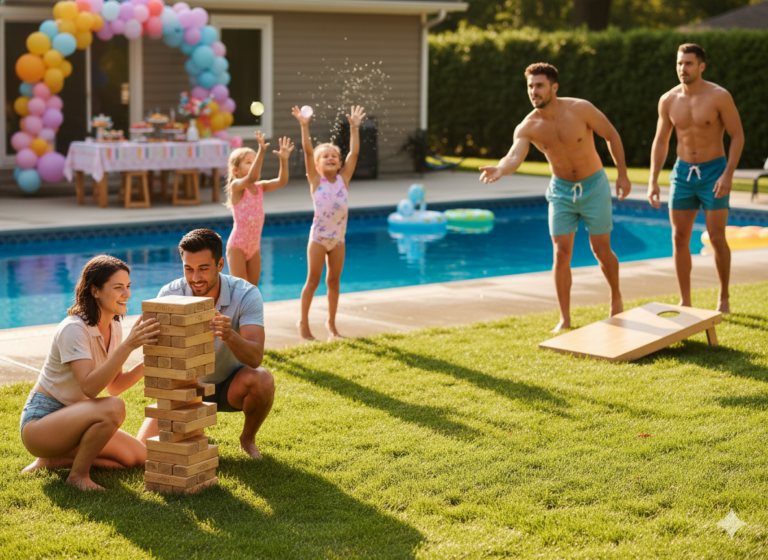
Giant Jenga with forfeit cards
A supersized Jenga tower where each block has a pool-themed forfeit or challenge written on it — “do a handstand in the pool,” “swap your pool float with someone,” “tell the group an embarrassing story,” “give the person to your left a compliment.”
Teenagers engage with this format because it’s social and slightly unpredictable. The forfeits give the game a reason to keep playing beyond the tower itself.
💡 Planning the right entertainment mix for your crowd is easier when you know exactly who’s coming. Splash Bash Pass tracks your full guest list and RSVP details — including ages — so you can plan games that actually work for your group. Try it free →
Games for Adults
For the full adults-only game guide, visit The Best Pool Party Games for Adults That Everyone Will Play →. Below are the highlights that work especially well in a mixed-age setting.
Watermelon push race
A greased watermelon pushed across the pool using only your nose, chin, or forehead. No hands. Every age group finds this hilarious without exception. Adults who swore they weren’t going to get in the pool get in the pool for the watermelon push race.
The watermelon costs $8–$12. You eat it afterward. The chaos it generates costs nothing.
Cornhole
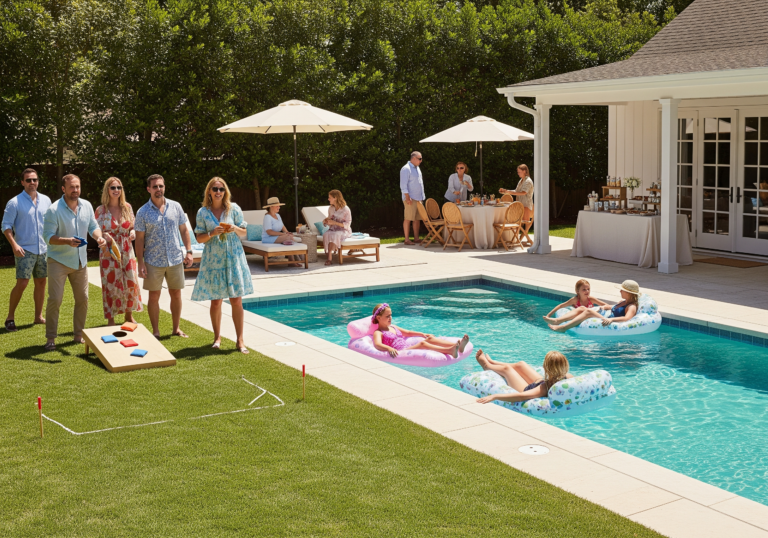
The most reliably played lawn game at any pool party. Set it up before guests arrive, and it runs itself all afternoon — kids, teenagers, and adults all drift toward it naturally.
The beauty of cornhole for a mixed group is that the skill ceiling is accessible enough for younger children to feel competitive without the game being boring for adults. A basic set runs $40–$80.
Bocce ball
Lower intensity than cornhole, slightly more strategy, works beautifully for the adults who prefer to stay on the dry side of the party. Runs happily on grass or gravel alongside everything else happening simultaneously.
Games for Mixed Groups — All Ages Together
These are the games worth knowing specifically because they work across age groups without requiring anyone to condescend or hold back.
Categories in the pool
One person calls out a category — pool-themed things, summer foods, Disney characters, sports teams. Going around in a circle, each person names one item in the category. Hesitate, repeat, or draw a blank, and you’re out.
Play it standing in the pool. Players who are eliminated take a step deeper or sit on the pool edge. The game runs at whatever pace the group sets and scales from four to twenty players.
No equipment. No setup. Completely self-managing once started.
Freeze dance with pool edition
Play music. When it stops, everyone in the pool must freeze completely — no moving, no floating adjustments, no catching their balance. Anyone who moves is out.
Young children are both the most enthusiastic participants and the worst at freezing, which makes it inherently funny for everyone watching. The combination of accountability and absurdity keeps all age groups engaged.
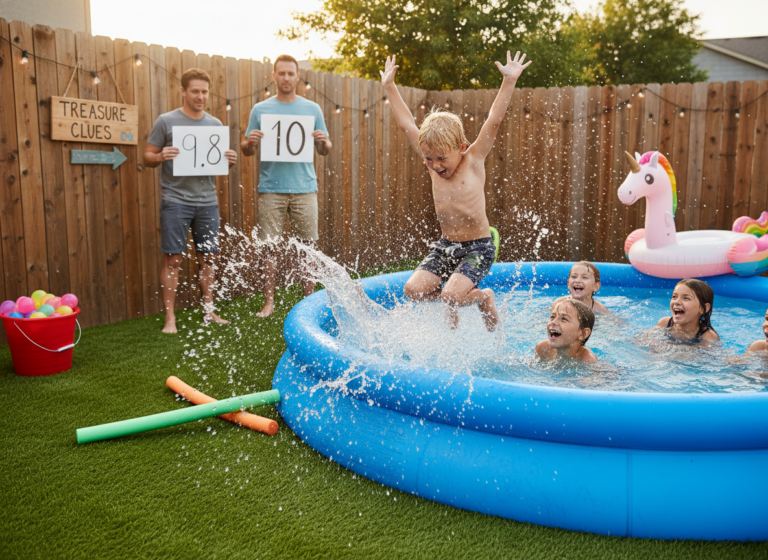
Treasure hunt
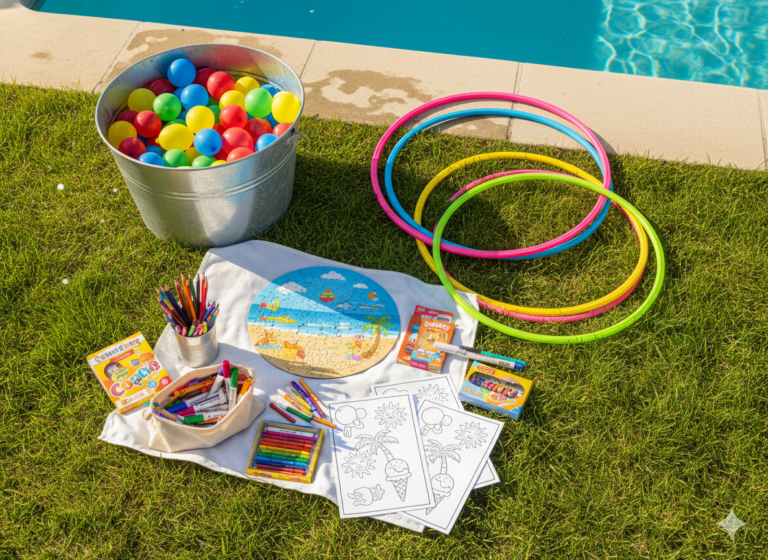
Scatter waterproof items — coloured rings, weighted dive toys, coins — across the pool floor. Give each player or team a list of what to collect. First to gather the complete set wins.
For young children: help them with the list and focus on the shallow end. For older children: have them collect in a specific order. For adults: add a blindfolded element where one partner directs the other.
The same game structure works for every age group simultaneously, with slight adjustments by team.
Tug of war across the pool
Two teams on opposite sides of the pool, each holding one end of a thick rope that runs across the water. The team that pulls the other into the pool wins.
Works best in a pool with consistent depth and where all participants are comfortable in the water. Generates significant noise and immediate competitive energy from all age groups.
A thick rope costs $10–$15. Set the boundary clearly and agree on the rules before you start.
Scavenger hunt around the yard
A list of items to find or tasks to complete around the party space — “find something pink,” “get a signature from someone who isn’t in your family,” “take a photo with someone wearing a hat.” Teams include one adult and one child.
This is the mixed-group game that builds the most genuine cross-generational connection. Pairing a six-year-old with an adult they don’t know well and giving them a shared task produces conversations and moments that outlast the game itself.
It also keeps children engaged and supervised without requiring any adult to stand and watch — the task structure does that work naturally.
Lawn Games Worth Setting Up Alongside the Pool
A pool party that only uses the pool misses an opportunity. The lawn beside the pool is prime game territory for guests who aren’t swimming — and having active options there keeps the whole space feeling alive rather than having all the energy concentrated at the water’s edge.
Lawn bowling or bocce
Quiet, strategic, and genuinely engaging for adults who want to stay dry. Easy enough for children to participate without fully understanding the strategy.
Spikeball
Fast, physical, and best introduced early before the afternoon settles into its relaxed phase. Works for teenagers and active adults. Generates spectators almost immediately. A set costs $50–$60.
Frisbee
No setup required. Scales from two people to a large group. It can be played casually across the lawn or turned into disc golf using cones or markers to create targets.
The Setup That Makes It All Work
The difference between a pool party where games actually happen and one where the equipment sits untouched is almost entirely in the setup.
Put the cornhole boards out before the first guest arrives. Float the diving rings into the pool at the start. Have the noodles and water balloons visible, not packed away in a bag.
When games are visually present and physically available, people interact with them naturally. When they’re stored away and require a host to go and retrieve them, the moment passes, and they don’t get used.
Set it all up the evening before. Walk out on party day to a space that’s already ready. Then spend the afternoon being present instead of organizing it.
For the adults-only game guide: The Best Pool Party Games for Adults That Everyone Will Play →
For the full planning walkthrough: How to Plan a Pool Party: The Ultimate Step-by-Step Guide →
For a complete prep checklist: The Ultimate Pool Party Checklist →
🐬 Let Marina Help You Plan the Whole Party
The right games are one part of a great pool party. Marina helps you handle the rest.
Meet Marina, your AI pool party specialist inside Splash Bash Pass.
🗓️ Guest list and RSVPs tracked in real time
💰 Budget tracking by category, planned vs actual
📣 Theme-matched invitations ready in seconds
📍 Top local vendors found near you via Google Maps
🛡️ Water Watcher assignments and safety checklists built in
☀️ Live weather monitoring with automatic backup plans
🎨 40+ curated themes with menus, décor, and music included
🪄 Paste your messy notes, and Marina organizes them instantly
Onboarding is completely free.