Pool Party Icebreaker Games: Fun Ideas to Get Guests Mingling
“This post contains affiliate links, and I will be compensated if you make a purchase after clicking on my links.”
The first thirty minutes of any pool party, where not everyone knows each other, can be a particularly challenging scenario for a host.
Guests arrive in ones and twos, grab a drink, scan for familiar faces, and hover at the edges. They check their phones, refresh their cups, and make small talk with whoever happens to be nearby.

Never use glass cups at a pool party — it is a real safety risk, and most people don’t realise until something breaks. I used to recommend clear acrylic cups, until I discovered Top Cup. Aluminum chills instantly, it doesn’t shatter, is reusable, and honestly it looks better than anything plastic I’ve ever put on a drinks table.
This isn’t unique to pool parties — it’s the standard arrival dynamic at any gathering where not everyone knows each other. But at a pool party, it’s more obvious.
The pool — the centerpiece of the afternoon — sits right there, sparkling, and nobody’s in it yet. Everyone is waiting for someone else to make the first move.
That’s where Pool Party Icebreaker Games come in. Too often, hosts skip them. Not because they don’t want guests to connect, but because the word “icebreaker” feels corporate, like a team‑building exercise that doesn’t belong in a backyard.
Get Brooke’s Free Pool Party Checklist
8 stages · 75+ checkpoints · print & tick your way to the perfect party
The truth? A pool party icebreaker doesn’t need to feel like an activity. The best ones feel like a game that just happened to be there — something light, playful, and perfectly timed.
They mix up the groups, spark laughter, and create the first real conversations of the afternoon.
The pool parties where guests are laughing in mixed groups by the forty‑five‑minute mark almost always had some kind of structured social push in the first twenty minutes.
It might be an arrival game, a mix‑it‑up challenge, or a low‑stakes activity that nudges guests to interact before they retreat into the familiar clusters they came with.
📣 Splash Bash Pass includes an activity guide and party timeline so the icebreaker, the main activities and the food service all land at exactly the right moment. Try it free →
This guide highlights the icebreakers that actually work at pool parties — tailored by crowd type, age group, and the level of host involvement required.
What Makes Pool Party Icebreaker Games Work
An icebreaker succeeds when it hits all three criteria below. If you miss even one, the game flops.
Keep It Low Stakes
The golden rule: no forced vulnerability. An icebreaker should never put guests on the spot, demand personal sharing, or showcase skills they didn’t volunteer.
That creates self‑consciousness — the exact opposite of what you’re trying to dissolve.
Instead, keep it light. Think playful prompts, simple actions, or group‑friendly mechanics that let guests ease in without pressure.
Active, But Not Athletic
At the start of a pool party, guests are dressed for swimming, not a relay race. Skip anything that requires heavy exertion.
The right icebreaker involves gentle movement: walking to find someone, standing in a group, jotting something down—enough activity to spark engagement, but never so physical that it feels like a workout.
Create Direct Interaction
The purpose of an icebreaker? Give two strangers a reason to speak. The game is just the mechanism.
If guests can play without exchanging a single sentence, the game is a failure. The best icebreakers spark quick conversations, laughter, and the first real connections of the afternoon.
👉 Key Concept: A pool party icebreaker works when it’s low‑stakes, lightly active, and designed to spark direct interaction. Nail all three, and you’ll transform those awkward first thirty minutes into the moment the party truly begins.
Get Brooke’s Free Pool Party Checklist
8 stages · 75+ checkpoints · print & tick your way to the perfect party
Icebreakers for Mixed Adult Crowds
Hosting a pool party with adults who don’t all know each other can feel like juggling floats in the wind — you want everyone relaxed, laughing, and mingling without forcing it.
The trick is to introduce activities that are light, specific, and just silly enough to break down the polite barriers. Below are four structured icebreakers, each designed to spark conversation and laughter while keeping the vibe casual.
1. The Float Bingo Card
How it works:
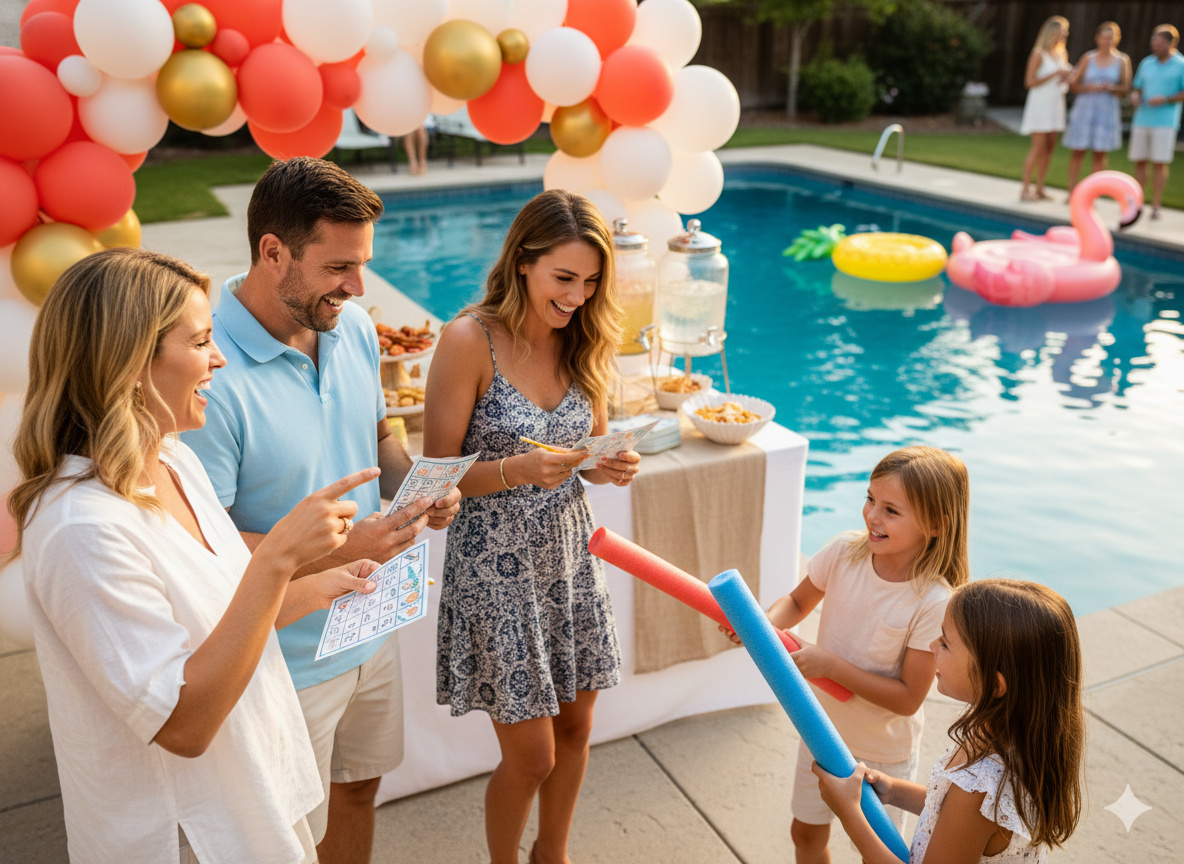
Each guest receives a bingo card filled with pool‑party‑specific prompts. Instead of generic “find someone who has traveled abroad,” the squares are cheeky and tailored to the setting:
- Owns more than three pool floats
- Can do a handstand underwater
- Has eaten watermelon this week
- Knows what a cannonball contest is
- Arrived at a pool party before the host was ready
Guests circulate, asking questions to match names to squares. The first to complete a row, column, or full card calls “Bingo!” and wins.
Why it works:
The specificity makes conversations real. Asking “Do you own more than three floats?” is oddly revealing, and it beats the tired “So, how do you know the host?” line.
Format:
Print cards on cardstock, set them by the entry with pens, and let the game run itself.
Prize:
Keep it small and themed — sunscreen, cocktail napkins, or a candle in the party’s color palette. Winning matters more than the prize itself.
“I’m always surprised at how many guests arrive at pool parties without sunscreen. That’s why I set out a few tubes of ANUA Zero‑Cast Moisturizing Finish Sunscreen for everyone to use. It’s water‑resistant, SPF 50, lightweight, and works for all skin types — my go‑to for keeping guests protected in the sun.”
2. Two Truths and a Lie
How it works:
Guests jot down three statements about themselves on index cards — two true, one false — but all must relate to pools, summer, or outdoor entertaining. Examples:
- “I once cannonballed into a pool at a formal event.”
- “I have never learned to swim.”
- “I once hosted a pool party during a thunderstorm.”
Cards are shuffled and read aloud. The group guesses which statement is the lie before the author reveals the truth.
Why it works:
The pool‑specific twist forces guests to dig up quirky stories. It’s funny, memorable, and avoids the awkwardness of standing alone in front of a crowd.
Format:
Provide index cards and pens at the entry or food table. Aim for about twenty cards before starting the reading session.
Prize:
Optional — but a playful pool‑related trinket (like a mini inflatable drink holder) adds charm.
3. The “Only Rule” Introduction
How it works:
At the thirty‑minute mark, the host gathers attention and announces:
“The only rule today is that before you leave, you need to know the names of three people you didn’t know when you arrived.”
That’s it. No further facilitation required.
Why it works:
It creates permission for introductions without pressure. The pool itself helps — strangers in water interact more naturally than strangers at a dinner table.
The rule gives everyone a ready‑made opener: “I need to meet three new people — I’m [name].”
Format:
A quick announcement, no props needed.
Prize:
None required. The reward is the ease of conversation itself.
4. The Celebrity Headband (Pool Edition)
How it works:
Each guest gets a sticky note on their forehead (or back) with the name of a pool‑party‑related celebrity, character, or object. They ask yes‑or‑no questions to figure out who they are.
Examples: flamingo float, sunscreen, Marco (from Marco Polo), Michael Phelps, cannonball, watermelon, lifeguard.
Why it works:
Absurdity fuels laughter. Asking “Am I living?” when you’re actually a pool noodle is instant comedy.
Format:
Prepare sticky notes in advance. Attach them as guests arrive or at a structured moment. End when everyone has guessed or after a set time limit.
Prize:
A lighthearted token — perhaps a pool‑themed drink stirrer or novelty sunglasses.
📣 Splash Bash Pass includes age-specific activity guides and a party timeline so every icebreaker, activity and food moment happens in the right order at the right time. Plan your timeline →
Icebreakers for Children’s Parties
Kids need structure that feels playful, not forced. These activities channel their energy into introductions that stick.
1. The Name Wave
How it works:
Children stand in a circle. The birthday child starts by saying their name with a chosen action — a jump, a clap, a spin, or a funny face. Everyone repeats the name and action. Continue until all children have had a turn.
Why it works:
Names become memorable through movement. Even shy kids get a moment of agency.
Age Range:
Best for ages 4–10.
2. Pool Noodle Introductions
How it works:
Each child gets a pool noodle. The host calls categories: “Touch noodles with someone whose birthday month matches yours” or “Touch noodles with someone wearing the same color.” Children move around finding matches.
Why it works:
The noodle makes interaction concrete and silly, removing the awkwardness of “go say hello.”
Age Range:
Works for ages 5–12.
3. Human Treasure Hunt
How it works:
Each child receives a card with five clues describing another child’s appearance. They circulate, find matches, and write names. First to complete wins.
Why it works:
Kids must observe and talk to each other, turning mingling into a clear task.
Age Range:
Ages 7–12, especially effective for mixed groups.
Icebreakers for Teen Crowds
Teenagers are the toughest audience for icebreakers. They have radar sharper than any lifeguard whistle for spotting activities that feel forced, corny, or condescending.
To win them over, the icebreaker must be three things:
- low‑key enough to avoid embarrassment,
- competitive enough to spark genuine engagement,
- brief enough to feel like fun rather than a school orientation drill.
1. The Playlist Vote
How it works:
Before the party, create a shared playlist link and send it with the invitation. Each guest adds one or two of their favorite songs.
When the party begins, the playlist plays in the background, but the first activity is a guessing game: match each song to the guest who added it.
Why it works:
Music is personal but not too revealing. Asking “Was that your song?” is a safe opener that works for shy teens and outgoing ones alike. The collaborative playlist also builds anticipation before the party even starts — guests are already invested in the soundtrack.
Format:
Digital playlist shared in advance. The guessing game can be played casually during the first hour.
Prize:
Optional. Control of the playlist for the next hour or a small music‑themed trinket works well.
2. This or That Tournament
How it works:
The host runs a rapid‑fire series of “this or that” questions, each tied to summer or pool life. Guests split into two groups based on their answer:
- Pool noodle or pool float?
- Morning swim or evening swim?
- Sunscreen or hat?
- Deep end or shallow end?
- Watermelon or popsicle?
Each question lasts twenty to thirty seconds. Guests move physically to opposite sides of the space, creating energy and laughter. After fifteen questions, the game ends. Total time: five minutes.
Why it works:
Binary choices remove performance pressure. Every answer is valid, and the speed keeps teens from overthinking. The physical movement adds energy without dragging on.
Format:
Designate two sides of the pool deck or yard. Keep questions quick and light.
Prize:
Not necessary — the fun is in the movement and discovery.
3. The Pool Hot Takes Board
How it works:
Set up a large piece of cardstock or a chalkboard near the food table. Write pool‑party prompts with space for responses. Guests add their answers throughout the first hour.
Prompts might include:
- “Most controversial pool party opinion”
- “The one pool party food nobody admits to loving”
- “Worst pool party injury story”
- “Best pool party you’ve ever been to — and why”
By mid‑party, the board becomes a conversation piece. Guests read, laugh, and add to it without needing to perform in front of a crowd.
Why it works:
The written format suits teens who avoid group activities but will jot down something funny or provocative. Reading others’ responses creates shared references that are sure to fuel conversation.
Format:
Place the board in a high‑traffic area. Provide colorful markers or chalk.
Prize:
None required. The board itself becomes the prize — a living snapshot of the party’s humor.
Icebreakers for Mixed‑Age Crowds
Family pool parties, milestone birthdays, or neighborhood gatherings often mix children and adults. The challenge is finding icebreakers that let everyone participate without anyone feeling out of place.
1. The Float Name Tag
How it works:
Each guest receives a blank name tag with a pool‑party prompt:
- “The last pool party I went to was…”
- “My pool party specialty is…”
- “The most fun I’ve ever had in a pool was when…”
Guests write their name and one fact. The fact becomes an instant conversation starter.
Why it works:
Children can read and respond to adult tags, and adults can engage with children’s tags. A seven‑year‑old’s “specialty is cannonballs,” and a forty‑five‑year‑old’s “specialty is charcuterie boards” are equally valid. The shared pool‑party domain levels the field.
Format:
Provide name tags and markers at the entry. Encourage guests to wear them for the first hour.
Prize:
Not needed. The payoff is the easy mingling.
2. The Poolside Trivia Round
How it works:
At the forty‑five‑minute mark, when most guests have arrived, the host runs a five‑question trivia round. All questions are pool‑party themed and multiple choice:
- What is the world record for the largest cannonball splash?
- How many gallons of water does a standard backyard pool hold?
- What year was the first residential backyard pool installed in the US?
- What is the proper chlorine‑to‑water ratio in a pool?
- What pool float shape was most popular in 2023?
Guests answer by a show of hands. No writing, no scorekeeping, no winners — just laughter at the absurdity of the answers.
Why it works:
Nobody knows the answers, so adults and children play on equal footing. The multiple‑choice format removes pressure, and the shared domain keeps the trivia lighthearted.
Format:
The host reads questions aloud. Guests raise their hands for their choice.
Prize:
None. The fun lies in the collective guessing.
📣 Splash Bash Pass includes age-specific activity guides and a party timeline so every icebreaker, activity and food moment happens in the right order at the right time. Plan your timeline →
Timing and Facilitation
Every pool party has a rhythm — arrivals, greetings, the first drinks poured, the first brave soul in the water. Icebreakers only work when they slip neatly into that rhythm.
The sweet spot is the first thirty to forty‑five minutes, after the initial trickle of guests but before the energy has fully settled into familiar clusters.
Too early, and the game feels forced — three guests standing awkwardly with bingo cards is not a connection, it’s homework. Too late, and the party has already self‑sorted into groups, making any structured activity feel like an interruption.
Spotting the Window
The trigger moment is simple: when about half the expected guests have arrived, and the natural lull in arrival energy hits. That’s when you casually introduce the icebreaker. Not with ceremony, not with a microphone announcement, but with quiet positioning.
The bingo cards are already on the table, the sticky notes already waiting in a bowl. The activity feels like it’s been there all along, ready for anyone who wants it.
Host Facilitation
The host’s role is light touch. A single sentence is enough:
“There are bingo cards on the table — grab one if you want. First one to get a row, come find me.”
Then step back. The host who pushes too hard makes guests defensive. The host who introduces it lightly and returns to their own conversation leaves the game available, not imposed.
Guests who want to play will play. Guests who don’t will still feel included, not pressured.
After the Icebreaker
It’s important to remember: the icebreaker is not the party. It’s the spark that helps the party ignite more quickly and burn more warmly.
The true measure of success isn’t whether someone shouted “Bingo!” or whether the lie was guessed correctly. It’s the forty‑five‑minute mark when every guest is in conversation, no one is hovering at the edge of their comfort zone, and laughter is carrying across the pool deck.
What Success Looks Like
- The conversation that started over a bingo square about owning more than three floats.
- The stranger who turned out to be the funniest person at the party was discovered because someone needed to check off “knows what a cannonball contest is.”
- The teen who realized the adult in the next chair added the same song to the playlist.
These are the moments the icebreaker was designed to unlock.
Beyond the Game
The game itself is disposable. What matters is what it makes possible: introductions that feel natural, conversations that feel easy, and connections that ripple through the rest of the afternoon.
The floats, the music, the laughter — all of it flows more freely because the icebreaker did its quiet job in the background.
✨ Think of the icebreaker as the starter’s pistol, not the race. It signals the beginning, sets the pace, and then disappears into the sound of splashing water and clinking glasses. That’s when you know it worked.
For the full activity framework that follows the icebreaker window, the pool party games for adults guide covers in-pool and on-deck activities for the main party hours.
For children’s activities that build on the icebreaker energy, the pool party games for kids guide covers every age group from arrival to the final swim session.
🎲 Let Marina Plan Your Pool Party Activity Timeline
Icebreaker guide, activity schedule, party timeline, and a complete party plan — Splash Bash Pass coordinates the whole afternoon, so the first thirty minutes set up the next four hours perfectly.
Meet Marina, your AI pool party specialist inside Splash Bash Pass.
🗓️ Guest list and RSVPs tracked in real time
💰 Budget tracking by category, planned vs actual
📣 Theme-matched invitations ready in seconds
📍 Top local vendors found near you via Google Maps
🛡️ Water Watcher assignments and safety checklists built in
☀️ Live weather monitoring with automatic backup plans
🎨 40+ curated themes with menus, décor, and music included
🪄 Paste your messy notes, and Marina organises them instantly
Onboarding is completely free.