Pool Party Games for Teens: 10 Easy Ideas That Work
Best Pool Party Games for Teens – A Quick Answer
The best pool party games for teens are competitive, performance‑driven, and never childish. Assign teams on arrival, keep a running leaderboard, and schedule 4–5 games in 30–45 minute blocks. Always designate an adult Water Watcher for safety.
The hardest pool party to plan is not the one with thirty toddlers. It is the one with fifteen teenagers.
Toddlers will play in a sprinkler for forty-five minutes. Teenagers will stand at the edge of the pool looking at their phones, insist they are fine, and then complain on the way home that the party was boring.
Not because they are difficult — they are not — but because most pool party games for teens are not designed for them. They are often meant for kids, and teenagers can see through them immediately.
Get Brooke’s Free Pool Party Checklist
8 stages · 75+ checkpoints · print & tick your way to the perfect party
Ring toss and pool noodle races are not the right pool party games for teens. What works for teenagers is games with real stakes, real competition, and enough social complexity that the game itself generates conversation.
This guide covers plenty that fits that description — water games, dry land games, team formats, and the structures that keep a teen pool party moving from start to finish without anyone announcing that they are bored.
What Makes a Good Pool Party Game for Teens?
Before going through the list, it is worth noting the difference between games that work for teenagers and games that do not. Games that work have a few things in common.
- They are competitive without being childish — there is a real winner, and the path to winning requires actual skill or effort.
- They allow for social performance — teens want to be seen doing well, and games that produce those moments generate energy.
- They have enough complexity that they cannot be immediately dismissed as something from a kids’ party.
- They scale — they are as fun with eight players as with fifteen.
Games that do not work:
- Tend to be too structured for an age group that wants to feel like they are choosing to participate rather than being directed.
- Anything that feels like a birthday party game for a younger child.
- Anything that requires elaborate setup with no payoff.
- Anything that puts a single person on the spot without peer support.
The framing matters almost as much as the game itself.
Call it “synchronized swimming judged by a panel of judges,” and it sounds stupid. Call it “who can do the most ridiculous pool trick and get the highest score,” and the same activity produces thirty minutes of competition.
You may also get some ideas from my earlier post, Best Pool Party Games for Kids: for Every Age. But be sure to improvise them for your teen pool party.
Teen Pool Party Games at a Glance
| Game | Where | Players | Time | What you need |
|---|---|---|---|---|
| Chicken Fight Tournament | In water | 8+ (in pairs) | About 45 min | Pool, neutral judge |
| Shark and Minnows (Teen Version) | In water | 8-15 | 20-30 min | Pool, whiteboard for scores |
| Marco Polo Tournament | In water | 8-15 | 3 min per round | Pool, bracket |
| Pool Noodle Jousting | In water | 2 at a time | 5 min per match | 2 noodles, 2 large floats, bracket |
| Relay Races With Challenge Legs | In water | Teams of 5 | 15-20 min | Pool, pool float, timer |
| Giant Jenga With Dares | Dry land | 4-10 | 30-45 min | Giant Jenga set ($25-$40), written dares |
| Watermelon Seed Spitting Contest | Dry land | Any | 15 min | Watermelon, painter’s tape, tape measure |
| Bocce or Cornhole | Dry land | Teams of 2 | Runs alongside other games | Bocce or cornhole set |
| Card Games (Spoons, UNO, Exploding Kittens) | Dry land | 4-6 per table | 15-30 min | Cards, spoons |
| Poolside Trivia | Dry land | Teams | 3 rounds of 10 questions | Questions, notepad, prizes |
Best In-Water Pool Games for Teens
1. Chicken Fight Tournament
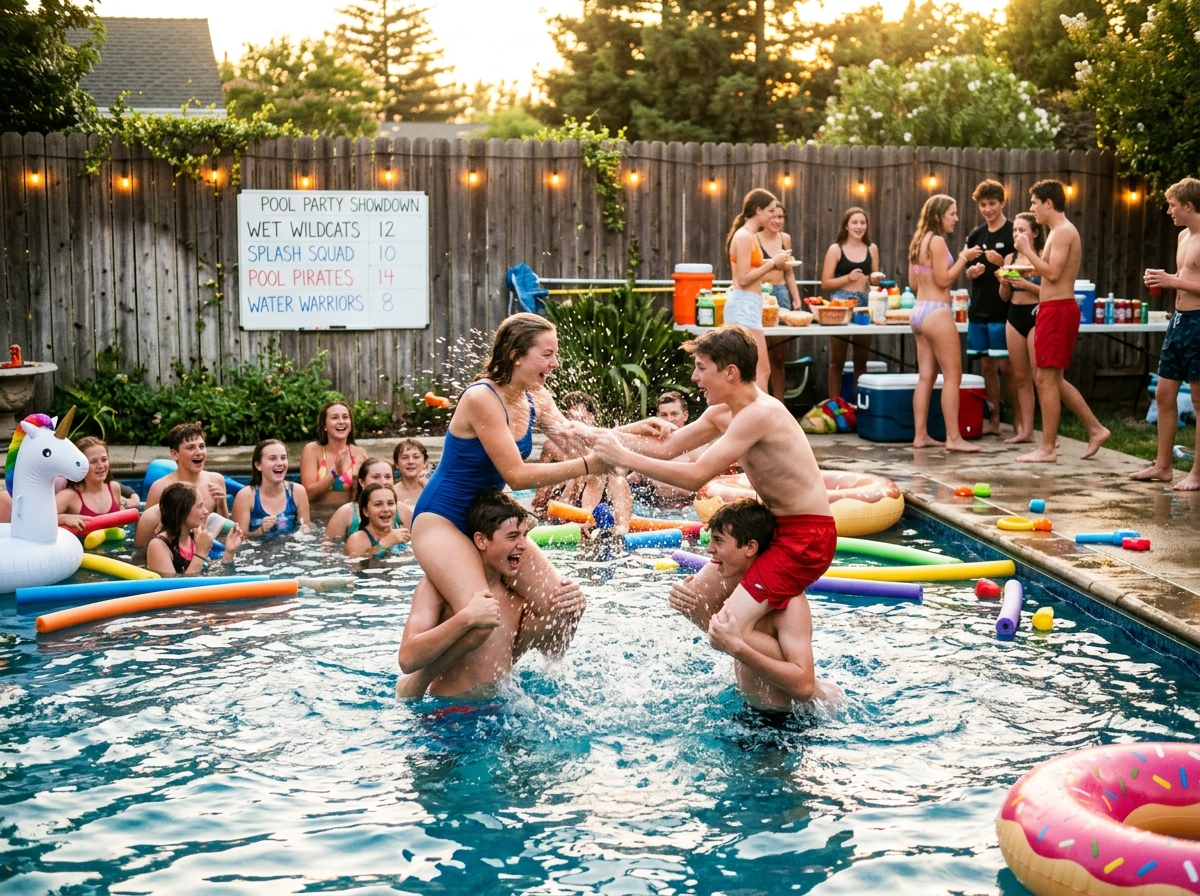
Two players pair up — one sits on the shoulders of the other — and the goal is to knock the other team’s upper player off. The team whose lower player stays standing wins the round.
Tournament format: bracket-style elimination, winners advance, a final round decides the champion.
Why it works: requires physical coordination between the partners; the stakes are high enough, so the teens really try. The game produces the kind of chaotic, entertaining moments that teenagers want to be part of.
Scales naturally: eight players make four pairs, which means two first-round matches and a final.
Sixteen players make eight pairs: four first-round matches, two semifinals and a final, which fills about forty-five minutes of structured competition without requiring anything except the pool.
Rules that keep it clean: no grabbing below the shoulders, no going for the head, the lower player cannot deliberately knock the opposing lower player. Call fouls clearly. Have a neutral judge.
2. Shark and Minnows (Teen Version)
The classic is too simple for teenagers. The teen version must add layers.
Start with two sharks. Tagged minnows become sharks immediately. Each round, the last three minnows standing score a point. Play five rounds and track scores on a whiteboard. The minnow with the most points across five rounds wins.
Add a power round: one round where minnows can only travel underwater — no surface swimming allowed. One round where sharks must keep one hand behind their back. One round where minnows must cross, holding a pool noodle above the water at all times.
These rule variations reset the energy of the game each round and keep the competitive interest from flattening out after the first twenty minutes.
SAFETY NOTE: cap underwater distance, no hyperventilating beforehand, never in deep water without a spotter, and a Water Watcher always on duty.
3. Marco Polo Tournament
The standard game: played tournament-style with a bracket. Each round lasts three minutes. The “Marco” player scores a point for each successful tag. At the end of three minutes, the next player becomes “Marco.” Whoever scores the most tags in their turn advances.
The teen upgrade: allow “Fish Out of Water” — any player who has left the pool (even one foot on the deck) can be called out by saying “Fish Out of Water.”
This forces full commitment to staying in the pool during each round and adds a level of social watchfulness that teenagers engage with immediately.
4. Pool Noodle Jousting
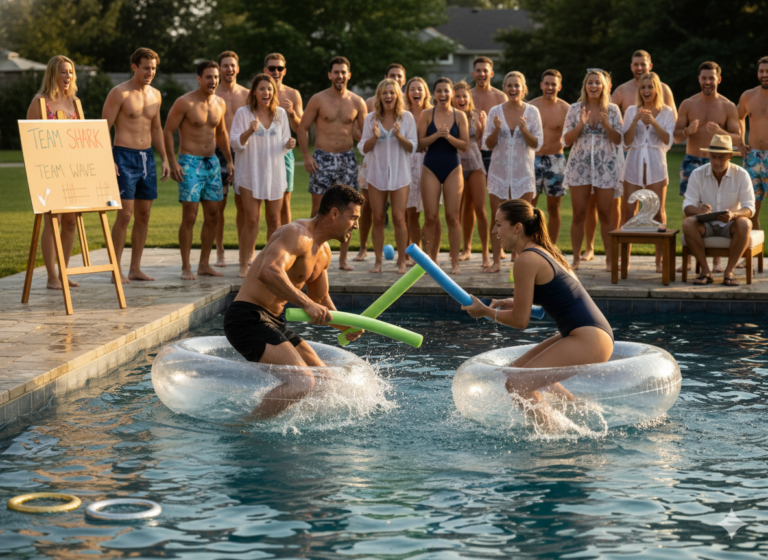
Two players stand on inflatable pool mats or large float platforms and attempt to knock each other off using pool noodles. One hit below the shoulders counts as a point. The first to score three points wins the match.
Equipment needed: two pool noodles, two pool floats large enough to stand on. This setup costs almost nothing if floats are already owned.
Tournament format across the afternoon. Announce the bracket at the start and keep it visible on a whiteboard or chalkboard near the pool.
Teens who are not currently playing will watch and provide commentary, which is part of what makes the game work — the audience participation is not incidental.
5. Relay Races With Real Stakes
Standard relay races — swim one lap, tag the next person — are too simple to hold teen interest. The version that works adds a challenge at each leg.
Freestyle lap, then underwater length, then backstroke lap, then doggy paddle only, then a length pushing a pool float with your nose, no hands.
Each team has five players, each covers one leg. Fastest team wins.
If the group is competitive, run heats and keep times. Post them on the whiteboard. Allow rematches. Teens who feel like the race was close will ask for another round, which is the outcome you want.
Get Brooke’s Free Pool Party Checklist
8 stages · 75+ checkpoints · print & tick your way to the perfect party
Dry-Land Games for Teens (No Swimming Required)
Not every teen at a pool party wants to be in the water at all times — and some guests will stay dry by choice throughout the afternoon. The dry land games need to be strong enough that staying out of the pool does not feel like missing the party.
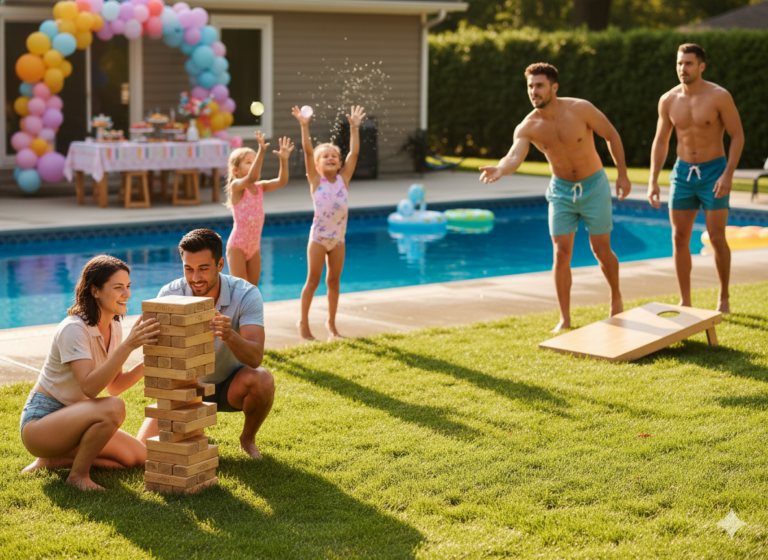
6. Giant Jenga With Dares
A standard Giant Jenga set — available for $25 to $40 and reusable at every future event — with a written dare on each block.
Players who pull their block must complete the dare before replacing it on top of the tower.
The dares for a teen pool party lean pool-adjacent rather than embarrassing: “jump in the pool with your clothes on,” “do a handstand in the water,” “sing the chorus of a song chosen by the group,” “compliment every person at the party before your next turn,” “let the group choose your next swim,” “do a dramatic slow-motion dive.”
Keep them physical and social rather than humiliating.
The Giant Jenga dare format works for teenagers because the dares give the game a social dimension that pure skill games lack — the moment when someone reads a dare and has to decide whether to do it produces more group energy than any athletic competition.
7. Watermelon Seed Spitting Contest
Low-tech, high return for a summer afternoon. Each player gets one quarter of a watermelon and three seeds. Farthest spit wins.
Mark the landing points with painter’s tape or chalk circles on the pool deck. A tape measure adds formality and, therefore, stakes.
The reason this works with teenagers is that it is absurd enough that no one feels like it is beneath them to participate.
The absurdity is the point. The Guinness World Record for the farthest distance to spit a watermelon seed is 75 feet 2 inches — worth announcing before the competition begins.
8. Bocce or Cornhole by the Pool
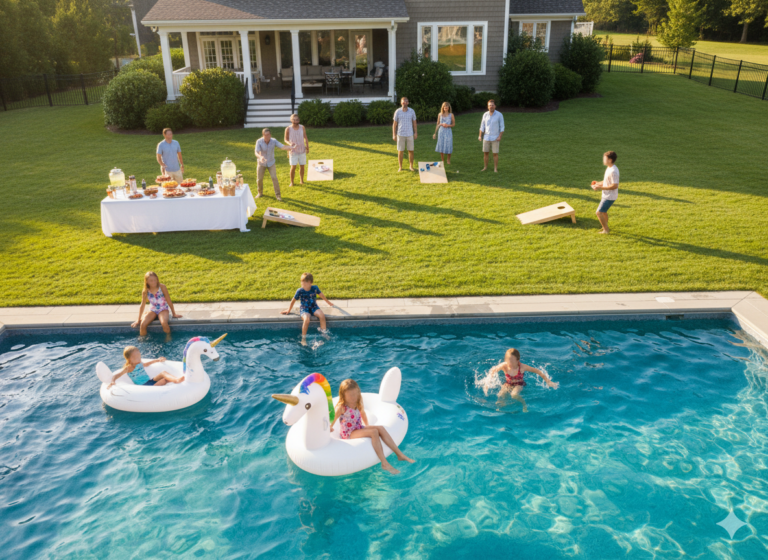
If the yard has space, a standard game of bocce or cornhole running alongside the pool games gives guests who want a break from the water a competitive activity that does not require getting wet.
Tournament format for bocce: teams of two, bracket play, losers’ bracket, so no one is eliminated in the first round.
Cornhole: same format. Keep it running alongside the pool games rather than as a replacement for them.
Both games work for teens because they are physical (aim), mental (strategy), social (interaction), and they scale naturally across a full afternoon.
9. Card or Dice Games at the Table
For teens who want to sit for a stretch, a card game that plays well in groups of four to six at a patio table is worth having available.
Spoons — a fast, physical card game where the goal is to grab a spoon from the center of the table before someone else does — works better at a pool party than most card games because the physical grab element maps onto the energy of the afternoon.
UNO is the default answer, and it works. Exploding Kittens or a similar card game produces higher engagement for the age group.
10. Poolside Trivia
Team trivia with a host reading questions — pop culture, sports, music, movies, swimming-related facts — and teams writing answers on a shared notepad. Three rounds of ten questions. Point values increase each round.
A big prize for the winning team and smaller consolation prizes for others.
The version that works best for teenagers: a round of questions about the guests themselves — “whose first concert was Taylor Swift?”, “Who on this guest list can juggle?” “Which person has been to the most countries?” — answered as a blind test before being revealed.
This format produces laughter and conversation and gives guests information about each other that they would not have exchanged in small talk.
How to Run a Teen Pool Party With Teams
The single structural move that makes a teen pool party run well from start to finish: assign teams at the beginning of the afternoon and run all the games as a cumulative team competition.
On arrival, each guest draws a team color from a bowl. Teams of four or five. Each game throughout the afternoon — chicken fight, relay race, trivia, Giant Jenga — scores points for the team. Points are tracked on a leaderboard (a whiteboard or a piece of poster board near the food table).
At the end of the afternoon, the winning team gets a prize — something small but tangible, like a gift card split between the team members, a custom ribbon, or the right to choose the last song of the afternoon.
This structure does three things that improve the entire party.
- It gives every guest an immediate social group on arrival. Eliminates the standing-awkwardly-at-the-edge problem for teens who arrive without their closest friends present.
- It gives every game higher stakes, because each result feeds the cumulative scoreboard.
- And it creates a narrative arc to the afternoon — the score shifts, the lead changes, the final result is not known until the last game finishes — that keeps engagement from flattening out after the first hour.
The team system requires a short & simple explanation at the start of the party and a designated scorekeeper.
The Phone Problem (And How to Solve It)
The standard recommended advice for teen pool parties is to confiscate phones. It is neither realistic nor necessary.
The goal is not to eliminate phone use — it is to create enough happening in the physical space that the phone becomes the less interesting option. Games with active scoring and ongoing results pull teens away from their phones more reliably than any rule.
What works: a designated “phone zone” — a dry table with a charging station where phones live safely while their owners are in the pool.
Teens who know their phone is safe and accessible are more willing to leave it than teens who are worried it will get splashed. Make the phone zone obvious and reliable.
Also: design at least one game that uses phones legitimately.
- A team trivia round in which one phone per team serves as the research tool for a “phone-a-friend” bonus question.
- A group photo challenge where teams score points for specific photographs completed across the afternoon — the most dramatic pool jump, the funniest poolside pose, the best underwater shot taken through the pool wall.
These games make the phone part of the party rather than a competition with it.
Best Music Setup for a Teen Pool Party
Teenagers are more particular about music than any other age group, and a playlist that reads as out of touch will undermine the atmosphere more than a missing decoration.
Two options that both work.
Option one: a collaborative playlist built in advance — ask each guest to add three songs before the party. The playlist reflects the group’s actual tastes and removes any debate about who is controlling the music.
Option two: let the birthday teen control the playlist completely. It is their party, and the social stakes of the music choice being right are real to them. Give them that decision fully rather than managing it.
What does not work: a parent-curated playlist from a decade that is not the present one, a radio station where ad interruptions break the momentum, or a sound system so quiet that it does not register across an active pool area.
Music at a teen pool party should be audible at the pool’s far edge. A centrally placed Bluetooth speaker turned up solves more atmosphere problems than a week of decoration planning.
Keeping the Energy Through the Full Afternoon
Teen pool parties have a natural energy arc. The first hour is high — everyone arrives, people get in the pool, and the first competitive game runs.
The third hour is the risk point — the initial novelty has worn off, the competition may be settled, and without structure, guests start checking their phones and calculating when to leave.
The moves that prevent the third-hour dip:
Announce the leaderboard at the two-hour mark. Read the team scores out loud. If one team is significantly ahead, introduce a double-points game to keep the result in question.
Change the game format. If the afternoon has been predominantly in-water, move to a dry land competition. If it has been predominantly competitive, introduce something social and low-stakes — a photo challenge, a trivia round.
The food moment. Time the cake or main food service at the two-hour mark rather than earlier. The meal transition resets energy and gives guests a reason to gather, which re-forms the group after the natural dispersal that happens as games wind down.
One more round. For any game that produced a close result, offer one more round at the three-hour mark. Teenagers who are not ready to leave will take the invitation. Those who are ready will use it as a natural exit point. The offer resolves the lull without forcing anyone’s hand.
Sample Schedule for a 4-Hour Teen Pool Party
| Time | Activity | Notes |
|---|---|---|
| 0:00-0:30 | Arrival, team draw, free swim | Guests draw a team color. Point out the phone zone. |
| 0:30-1:15 | Chicken Fight Tournament | Bracket on a whiteboard, adult referee on duty. |
| 1:15-1:45 | Relay Races With Challenge Legs | Run heats and post times. |
| 1:45-2:00 | Free swim | Unscheduled break so the group can reset. |
| 2:00-2:30 | Food, cake and leaderboard | Announce team scores. If one team is far ahead, make the next game worth double points. |
| 2:30-3:00 | Dry-land game | Giant Jenga With Dares or Poolside Trivia. |
| 3:00-3:30 | Marco Polo bracket or Noodle Jousting | Offer one more round for any close game. |
| 3:30-4:00 | Final game, prize, and last song | The winning team picks the last song. |
Keep It Safe: Rules for Rough Pool Games
Competitive games are the whole point of a teen pool party, and they’re also where most injuries happen. A few rules keep the energy high and the risk low.
- Keep an adult on duty at all times. One adult, phone down, whose only job is watching the water. Rotate Water Watchers in short shifts so no one drifts.
- No diving in shallow water. Set the rule before anyone gets in, and make it clear which end of the pool is for jumping and which is not.
- Referee the contact games. Chicken fights and noodle jousting need an adult referee, no head contact and no grabbing, and the game stops if anyone struggles.
- Know that jousting from floats is where heads get hit. Falls off an unstable float can mean a collision with the float, the deck or another player, so joust only in water deep enough to land in safely and well away from the pool edge.
- Limit underwater challenges. Keep underwater rounds short, ban breath-holding contests and never let teens hyperventilate beforehand, because it can cause blackouts underwater.
- Stop a game when it turns rough. If a match gets aggressive or someone looks tired or panicked, end the round and reset.
For a full rundown of Water Watcher rotations, equipment and rules, see Pool Party Safety Tips Every Host Needs to Know.
The Quick-Reference Game List
For anyone planning a teen pool party who wants the condensed version:
In-water, competitive: Chicken Fight Tournament, Shark and Minnows (team scoring), Marco Polo bracket, Pool Noodle Jousting, Relay Races with leg challenges.
In-water, casual: Diving competition with judge scores, cannonball contest, handstand contest, longest-float-without-moving challenge.
Dry land, competitive: Giant Jenga with dares, Bocce or Cornhole tournament, Watermelon Seed Spit, Poolside Trivia teams.
Dry land, social: Photo challenge with phone cameras, collaborative playlist building, guest trivia (questions about each other).
Team format: Assign teams on arrival, run all games under team scoring, track on a leaderboard, announce results at the two-hour mark, award a prize at the close.
Pick four or five games from across the list, build a loose schedule with thirty to forty-five minute blocks for each, and leave unscheduled time for free swim. That structure covers a four-to-five-hour teen pool party without over-programming it.
Pool Party Games for Teens – FAQs
What pool party games work for teens?
Competitive, social games like chicken fight tournaments, Shark and Minnows, Marco Polo brackets, pool noodle jousting, relay races, Giant Jenga with dares, trivia, cornhole, and bocce.
How do you keep teens from getting bored?
Assign teams at arrival, run games as cumulative competitions with a leaderboard, announce scores mid‑party, switch formats when energy dips, and time food service to reset the group.
What games can teens play out of the water?
Giant Jenga with dares, watermelon seed spitting, bocce or cornhole tournaments, card games (Spoons, UNO), and poolside trivia.
Should you take teens’ phones away during the party?
No. Create a dry phone zone with charging stations and design one or two games that use phones, like a photo challenge or trivia with a phone‑a‑friend bonus.
How many games should you plan?
Four or five games in 30–45 minute blocks, plus free swim. This fills a 4–5 hour party without over‑programming.
How do you keep rough pool games safe?
Have an adult Water Watcher, referee contact games, ban diving in shallow water, and keep underwater challenges short. See Pool Party Safety Tips Every Host Needs to Know for the full rules.