Best Pool Party Games for Kids: for Every Age
The best pool party games for kids are the ones they are still talking about three days later. Not the most elaborate setup. Not the one that required the most preparation.
The one that produced the moment — the cannonball that soaked the entire pool deck, the treasure hunt clue that seemed easy but was actually quite misleading, the water balloon that hit its target and made everyone go “wow”!
That moment does not require expensive equipment or a professional party entertainer. It requires one good game, chosen for the right age group, with clear enough rules that the game can run smoothly without adult interference.
Children at a pool party, left entirely to their own devices, will entertain themselves for about twenty minutes before their energy either disperses or coalesces into something chaotic.
A single well-chosen game at the right moment extends the twenty minutes of drifting energy to sixty minutes of intense engagement. That is a meaningful difference in any party.
This guide covers everything you need:
- the age-specific framework that determines which games actually work for which children,
- the best in-pool games for swimmers at every confidence level,
- the best on-deck and lawn games for non-swimmers and breaks from the water,
- the treasure hunt structure that works at every age and every theme,
- and the game timing and facilitation guidance that makes activities land rather than fall flat
Here is the list of games worth planning.
📣 Splash Bash Pass includes an age-specific activity guide and game timing suggestions built around your guest count and party duration. Try it free →
The Age-Specific Framework: Why It Matters
The single most common kids’ pool party game mistake is applying a game designed for an eight-year-old to a five-year-old group — or worse, an eleven-year-old group — and wondering why the energy dies.
Children in different age brackets have fundamentally different game requirements.
Under-fives need sensory play and immediate physical engagement with no rules to follow. Five to eight need structure, competition, and a clear win condition they can understand. Eight to twelve-year-olds need a challenge, real stakes, games they could theoretically lose — because winning means nothing if losing is impossible.
Plan the game list for the actual age of the children attending. Not the age range on the invitation category. The specific children who will be in that pool on that afternoon.
For a mixed-age group — which most parties are — plan games in two tiers: a water play format that all ages can participate in simultaneously, and a structured game with age-calibrated difficulty for the main activity window.
In-Pool Games
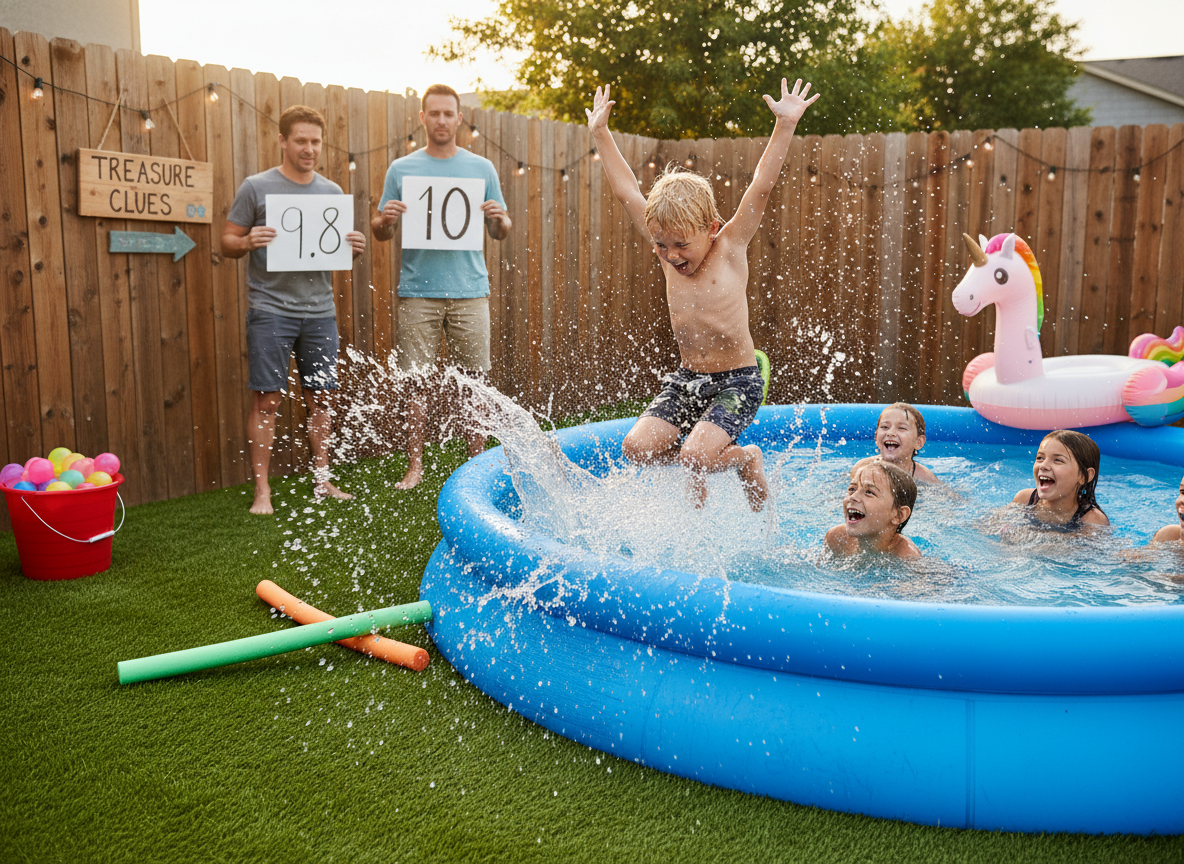
Cannonball Contest
The simplest and most universally successful pool party game for children aged five and above.
Mark a judging panel of two or three — other children or adults who are clearly enthusiastic about the role — and announce the competition with appropriate ceremony. Each contestant jumps or dives from the pool edge. Each jump is scored based on three criteria: splash size, jump height, and style.
The three-category scoring system adds to the fun and participation level. It means there are three potential winners. More kids have a shot at a prize! Categories can be adjusted — biggest splash, best trick, funniest style — depending on the group.
Run two or three rounds. Award a prize for each category. Keep the judging criteria ridiculous enough that the scoring produces laughs rather than arguments.
This game requires no equipment, no setup and no ongoing facilitation. It gets the kids to engage, compete, and have a great time! Moreover, the photographs from a cannonball contest are consistently the best photographs of the afternoon.
Age: 5 and above. Confident swimmers only. No cannonballs for non-swimmers.
Marco Polo
The most reliably engaging in-pool social game for children aged six and above.
One child is Marco. Eyes closed, they call “Marco.” All other swimmers in the pool respond “Polo” and try to swim away without being tagged. When Marco tags another swimmer, roles reverse.
The game self-organises and self-maintains with minimal adult facilitation once the rules are explained. It works in pools of any size with any number of children above three. It encourages swimming, spatial awareness, and social interaction.
Age: 6 and above. All swimmers.
Diving Ring Hunt
Drop a set of waterproof diving rings — or a collection of coins, small weighted toys, or any object that will sink — to the pool floor. Children dive to retrieve them, competing for the highest total over a set number of dives.
A simple points variation: assign different point values to different colored rings. Red is worth five points, blue is worth three, and yellow is worth one. Children dive strategically rather than just racing for the nearest ring.
For younger or less confident swimmers, run this game in the pool’s shallow end. The game still works, and nobody is excluded for not being a strong enough diver.
Age: 6 and above. Swimmers who are comfortable putting their face in the water.
Noodle Jousting
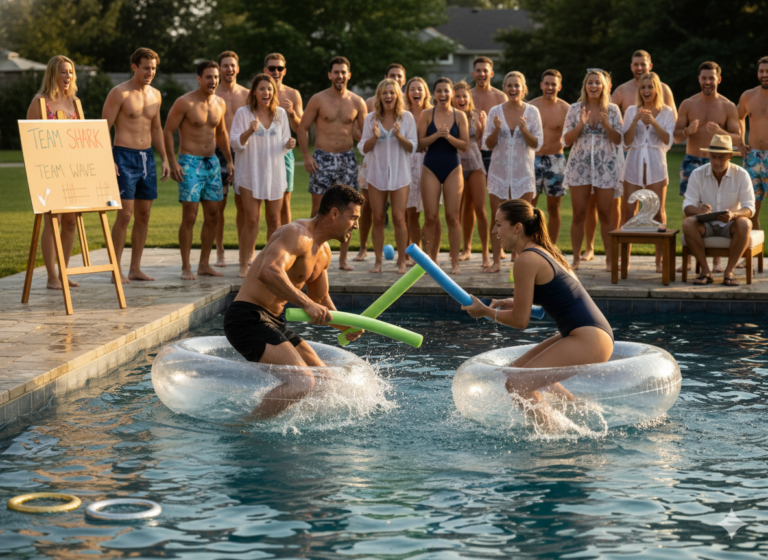
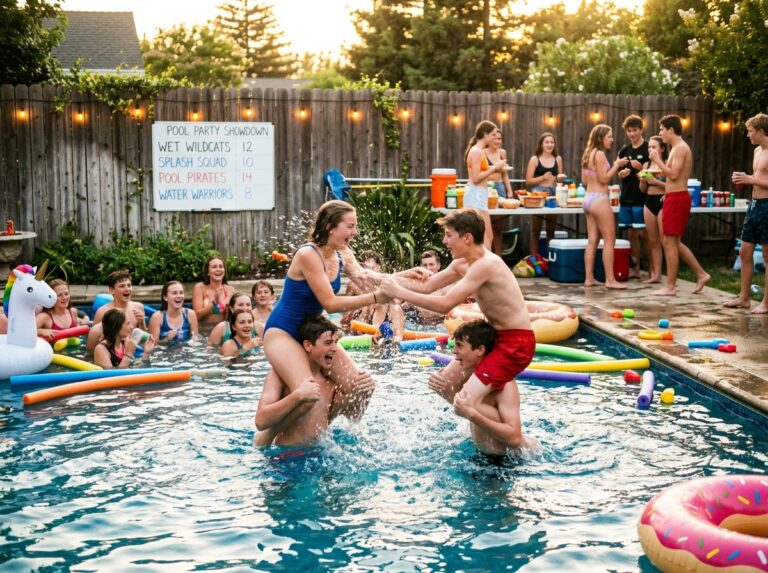
Two children sit on large pool floats facing each other — a li-lo, an inflatable seat, or simply a large ring float — each holding a pool noodle. They try to knock the other off their float using only the noodle, no touching.
The last person still on their float wins the round. Run as a tournament bracket for larger groups.
This game produces continuous laughter from spectators, requires minimal equipment, and is hilarious to watch, regardless of age. Adults who are supposed to be facilitating consistently end up wanting to join.
Age: 7 and above. Comfortable in the water, able to swim back to the float independently after falling in.
Shark and Minnows
All swimmers except one line up at one end of the pool. The single player in the middle — the Shark — calls “Minnows, minnows, cross my ocean.” All swimmers must swim from one end to the other without being tagged. Tagged swimmers become sharks. The last untagged minnow wins.
This is the pool equivalent of the classic playground game British Bulldog. It scales to any number of players and gets more chaotic and more enjoyable as more sharks are added. The game ends naturally when all minnows become sharks.
Age: 7 and above. Confident swimmers. The physical contact element requires children who can manage incidental bumping without distress.
Watermelon Push
Place a watermelon (or a large round float if you prefer) in the water, one for each swimmer. They must push it to the other end of the pool using only their nose or forehead. No hands.
This game is slower, more comedic, and more unusual than most pool games. The visual of a line of children slowly pushing watermelons across a pool produces immediate, sustained laughter from everyone watching.
It works best as a timed individual challenge rather than a race.
For the full relay format, pairs of children work together, handing off the watermelon at the midpoint without using their hands. The coordination required makes it even funnier.
Age: 7 and above. Confident swimmers.
Underwater Tea Party
For younger swimmers who are practicing putting their face underwater, a coordinated underwater tea party. Participants sit on the pool floor in a circle, everyone dunks simultaneously, and “drinks tea” before surfacing.
This is a gentle, cooperative activity, played in the shallow end, that builds confidence while producing some real hilarity. No competition, no rules beyond the simultaneous dunk. The coordination attempt usually fails spectacularly in the best possible way.
Age: 5 to 8. Appropriate for children who are working toward confident submersion.
Frozen T-Shirt Race
Freeze a wet t-shirt per child in a solid block of ice the night before the party. At game time, each child receives their frozen t-shirt and races to be the first to thaw it and put it on.
This is not a pool game in the conventional sense — it happens on the pool deck or lawn — but it belongs in the pool party game list because the chaotic, hilarious energy it produces is perfectly suited to an outdoor summer setting.
Children try every technique — sitting on the ice block, running with it, pouring water on it — and the whole thing takes about fifteen minutes of sustained enthusiastic effort.
Prepare the frozen t-shirts in zip-lock bags the evening before. One per child is the right format for a birthday party. For a larger group, run it as a team event with two to three teams sharing one block.
Age: 6 and above. No swimming required.
On-Deck and Lawn Games
Water Balloon Toss
Pair children up. Each pair starts close together, tossing a water balloon back and forth. After each successful catch, both players take one step backward. The last pair with an intact balloon wins.
The game is simple to explain and self-managing once in progress. The tempo builds up as the successful pairs move further and further away, and the balloon toss becomes more precarious.
Prepare water balloons in advance — fill them the morning of the party and keep them in a bucket of cold water. Count roughly four to six balloons per child for the full game duration, plus inevitable pre-game breakages.
Age: 5 and above.
Duck Fishing
Fill a paddling pool or large tub with water and plastic ducks. Mark the underside of some ducks with colored stickers. Children fish them out using small nets or their hands. Marked ducks earn prizes.
This works specifically for under-fives and is certainly more engrossing for this age group than almost any other structured pool game.
The combination of water, small animals, and the possibility of winning results in sustained focus in children who would otherwise struggle to participate in structured games.
Set up the duck fishing station away from the main pool so very young children have their own water play zone. Keeps the very young kids away from the main pool, too! No safety worries here.
Age: 2 to 5. The ideal under-five pool party activity.
Sponge Race
Cut large sea sponges in half. Divide the kids into two teams. Each team has a bucket of water at one end and an empty bucket at the other. The kids are required to dip their sponge in the full bucket, race to the empty bucket, and squeeze out the water to fill it.
race back. First team to fill their bucket wins.
This game is fast, physical, gets everyone wet without requiring swimming, and works beautifully as a cooldown game between pool sessions. The winning team is the one that fills the empty bucket the most in, say, 15 minutes.
Any kid can play this game, get wet, and still stay completely out of the main pool — they are participating fully in the party’s water activities without the depth anxiety.
Age: 4 and above. Excellent for mixed-swimmer groups.
Balloon Stomp
Tie an inflated balloon to each child’s ankle. On the starting signal, everyone tries to stomp on and pop everyone else’s balloon while protecting their own. The last child with an intact balloon wins.
No water required. No swimming. No equipment beyond balloons and string. The game is self-contained, self-managing, and produces the kind of chaotic, squealing energy that children aged five to ten find absolutely compelling.
Run it on the lawn away from the pool edge so children are not running near the water during the high-energy phase of the game.
Age: 5 to 10. Excellent on-deck or lawn option.
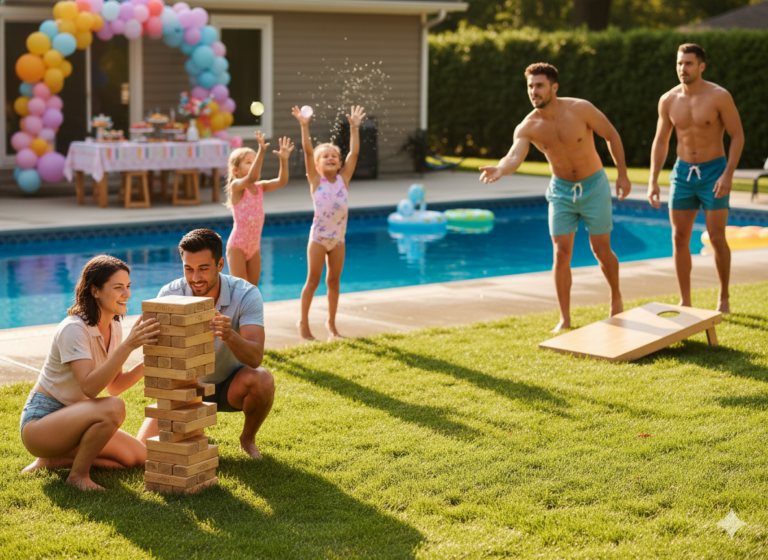
Giant Jenga or Lawn Bowling
A set of giant wooden Jenga blocks on the pool deck, or a simple lawn bowling setup — six full bottles of water as pins, a soft ball from the toy bucket — provides an ongoing low-energy game option for children who want a break from the water without leaving the party.
These games do not need facilitation and do not need to produce a winner to provide value. They are the activities the quiet child gravitates to between swim sessions.
Such games even catch the attention of the adults sitting nearby, and they suddenly find themselves deeply invested in a giant Jenga tower.
Age: 5 and above. All abilities.
The Treasure Hunt
The treasure hunt is the game that pool party themes were invented to support.
More than any other game on this list, the treasure hunt is the one that creates the afternoon’s defining memory. Not just a fun activity — an event within the event, with a beginning, a middle, and a conclusion.
The children who participated in a properly built treasure hunt have a shared experience they reference afterward that is specific to this party.
Building the Hunt
A well-built treasure hunt has four components.
The narrative
Before the hunt begins, someone (usually the host) establishes the story — why there is treasure, who hid it, and what the stakes are.
For a pirate party, the narrative is built into the theme. For a mermaid party, a mermaid queen left treasure that needs to be found. For a general pool party, a mysterious note appears — “The Pool Party Treasure was hidden somewhere in this yard by someone who left without telling anyone where. Follow the clues.”
The narrative does not need to be elaborate. It needs to be delivered with commitment.
The clue cards
Five to eight clues, each written in simple rhyme for younger children or as a riddle for older ones. Each clue leads to a specific location in the party space — under the towel basket, behind the third tiki torch, inside the cooler, beneath the sun umbrella.
Write them on small cards or fold them into “message in a bottle” tubes for visual appeal. Age the paper with a quick pass over a low oven or a light brush of cold tea for a more authentic map feel.
The route
Test the route before the party. Walk the clues yourself and make sure each one leads clearly to the next location without ambiguity. A clue that leads to two possible locations ruins the hunt’s momentum and produces arguments.
The treasure
A small treasure chest — available from craft stores or party supply retailers — filled with gold coin chocolates, small plastic gems, age-appropriate small prizes, and a few pieces of the birthday person’s favorite candy.
The chest should be genuinely hidden — partially buried in a sandbox, inside a box inside a box, under a pile of soft toys — rather than just placed in a visible location with a clue pointing to it.
Hunt Formats by Age
Under 6: Keep clues to three or four simple picture-based or single-word clues. Parents or older siblings accompany each child.
The treasure is found as a group and shared equally. The duration of the hunt should be ten to fifteen minutes — young children cannot maintain narrative engagement beyond this window.
Ages 6 to 9: Five to six clues in simple rhyme. Groups of two to three children working together.
Separate starting locations so groups are not following each other to the answers. Hunt duration can be from fifteen to twenty-five minutes. Give a worthwhile prize for the winning group, plus a consolation prize for all participants.
Ages 9 to 12: Eight to ten clues with creative riddles rather than rhymes. Go for an individual or pairs format.
Multiple possible starting clues that converge at a single mid-point and then diverge again. Hunt duration can be from twenty-five to forty minutes. The puzzle quality is what this age group engages with — make the clues really challenging without being unsolvable.
Timing and Facilitation: Making Games Land
The best-designed pool party game will fail if the timing is wrong or the facilitation is flat.
When to Run Each Game
The first twenty minutes after all guests have arrived should be unstructured pool time. Children need to settle into the space, reconnect with friends, and get wet before they are ready to focus on a structured activity.
The first game runs at the thirty to forty-minute mark, when everyone is comfortable in the pool but before the energy starts to drift.
The treasure hunt, if included, runs as the main event, one to one and a half hours into the party, after the first game has run and before food. It is the climax activity, not the arrival activity.
Food follows the treasure hunt. The hunt’s energy peak transitions naturally into the satisfaction of eating.
The cannonball contest runs after food, when children are back in the pool with renewed energy, and the afternoon light is at its best for photographs.
The final thirty minutes before collection is unstructured water play. No facilitation required.
How to Facilitate
Announce each game with enthusiasm and specificity. Not “does anyone want to play a game?” but “everyone out of the pool, we are about to find out who has the biggest cannonball in the whole yard, and the judges have been briefed.”
The first to participate sets the energy level. Position a willing, enthusiastic participant to go first rather than waiting for a volunteer. The crowd responds to the energy of the first participant more than to the game itself.
Keep rules short. Explain them in thirty seconds, demonstrate once, and start. Children learn games by playing them, not by being briefed.
A rule question that arises during the game is easily answered. A five-minute pre-game rules explanation kills the momentum before the first player enters the water.
Managing the Child Who Does Not Want to Participate
At every pool party, there is at least one child who stands at the edge of the game without joining. Such kids are not a problem to be solved. They are participants who prefer to observe rather than play the game.
Do not pressure them to join. Do not single them out. Continue facilitating for the children who are playing.
The observing child will either join in their own time — which most do, once the game proves itself worth joining — or they will continue watching happily from the edge, which is also a valid form of participation.
The game that pressures reluctant children to participate produces resistance and tears. The game that is clearly enjoyable enough that even the observers want in produces the moment you were planning for.
Safety During Pool Party Games for Kids
Pool party games and water safety are not competing priorities. They are the same priority.
Every game near or in the pool requires a designated water watcher whose sole responsibility during the game is watching the water — not participating in the game, not cheering from the sideline, not refilling drinks. Watching the pool.
The cannonball contest in particular — which produces the most physical energy and the most water entry of any pool party game — requires a water watcher positioned specifically to observe each child entering and exiting the water.
Games that involve physical contact in the water — noodle jousting, shark and minnows — require the water watcher to be positioned where they can see the full pool surface clearly and respond immediately.
Non-swimmers must be in a properly fitted life vest during any in-pool game, even if they are in the shallow end. The social excitement of a pool party game produces impulsive behaviour in children who are ordinarily cautious about water depth.
For the complete water safety framework, including watcher rotation and life vest guidance: Pool Party Safety Tips Every Host Needs to Know →
The Game That Makes the Party
The cannonball contest. The treasure hunt that led to the pool edge. The noodle jousting round where the smallest child knocked over both older competitors in the same thirty seconds.
These are not games. They are the stories that come out of a well-planned afternoon and get told at every family dinner for the next month.
No game on this list requires significant investment or elaborate preparation. They require a clear choice, a committed facilitation, and the right timing. The rest is what happens when children are given a good game, a warm pool, and the day off from school.
For more activities that extend the party beyond the pool, the pool party games for adults guide covers the parallel adult game list.
The pool party activities guide covers the broader activity framework for mixed-age parties.
And for the full planning structure that puts games in context, the kids pool party guide covers every age group from toddler to pre-teen.
🎯 Let Marina Plan the Games for Your Kids’ Pool Party
Age-specific game list, activity timing guide, treasure hunt template, and a water watcher rotation — Splash Bash Pass coordinates every element of the kids’ pool party so the games run exactly as planned. Use the app to find local party suppliers and entertainers near you.
Meet Marina, your AI pool party specialist inside Splash Bash Pass.
🗓️ Guest list and RSVPs tracked in real time
💰 Budget tracking by category, planned vs actual
📣 Complete Glow theme plan with lighting setup, decor, and music direction
📍 Top local party suppliers and UV equipment rental found near you via Google Maps
🛡️ Water Watcher assignments and safety checklists, including after-dark pool safety
☀️ Live weather monitoring with automatic backup plans
🎨 40+ curated themes including Glow, Night Pool Party, Neon, and more
🪄 Paste your messy notes, and Marina organizes them instantly
Onboarding is completely free.